Richard Oldfield interview: Part II
In part two, Oldfield highlights emotional discipline, Value traps, managing concentrated portfolios and the lunacy of passive investing. He discusses reforming Oxford’s endowment, family wealth, AI, market arrogance, and his personal interests.
JS: You have said that the hardest part of investing is emotional discipline. Can you give examples from your own historical positions where your conviction was severely tested?
RO: The outstanding example was the crash in 1987 when I was working at Mercury. I was the head of the US equity team. I was in fact on holiday and I rang up on the Monday morning be told that the Dow Jones was down 500 points and amidst the storm which had caused many of the trees in England to fall down. I remember thinking it was not very significant really and my first instinct was that meant things were a great deal cheaper, 25% cheaper than they'd been the previous day. Anyway, I went back to work though I was on holiday because I thought I should and I was immediately infected with sort of general gloom and the strategy committee decided, with no dissent, (I'm sure I was completely supportive as there was nobody who wasn't supportive) to go to 40% in cash in our global equity portfolios and of course that turned out to be a terrible error which ruined the international performance for the next several years. That's an example when emotion gets the better of you and standing back from it all being asleep or on holiday as I had been would have been a much better thing to be.
We were investors in RBS in in 2008. On October the 8th, I think it was, we heard the lugubrious tones of Robert Peston on the BBC. He was breaking the news that RBS was going to have a recapitalisation. We sold because, with the extent of dilution which there was likely to be, the existing shareholders were more or less rubbed out. That was a time which was extremely emotional and stressful and difficult. When we took that decision, I can't say we took it unemotionally. It was very difficult to take this but, in this case, it was the right decision because the shares went a great deal lower.
I do think that the temperament to deal with that stress is very important
JS: Do you have any rules of thumb for distinguishing between a Value trap versus a Value opportunity or is it not obvious?
RO: a Value trap is something which looks very good value but has a huge amount of debt and is cyclical. To combine very heavy operational leverage with financial leverage is very dangerous because you never know what's going to happen. We don't attempt to forecast economic cycles and you therefore have to have a balance sheet which can withstand a long cycle.
Some of our mistakes have been where these things have combined. So I would say one rule of thumb is do not combine high financial and operation operating leverage and the other rule of thumb which I don't think I've sort of developed sufficiently to be a rule of thumb but it is in a way is that some things really are too cheap and they're telling you that this isn't about valuation at all. They're telling you something quite outside the realms of valuation. So, for example, when Russian oil companies were valued at two times earnings before 2022, what you were really being told by clever Mr. Market - who always knows more than any of us - was that there was a major risk that you wouldn't be able to sell those Russian assets in the future, they would be frozen through sanctions. So there is a level at which you have to think beyond valuations.
JS: You are an advocate of fairly concentrated portfolios. How do you decide when a position has become too concentrated and are there different portfolio formats where different parameters might apply?
RO: I strongly believe that a concentrated portfolio makes for a concentrated mind. And to those who criticise that that kind of way of doing things, my feeling is that if we had a 60 stock portfolio, we're just as likely to get three stocks hopelessly wrong as in a 20 stock portfolio, one stock hopelessly wrong. But we do believe in diversification. Portfolio construction diversification across sectors and countries is very important and you can do that with portfolio of 15 stocks. The studies that show that every extra stock over 15 names does very little in terms of reduction in risk.
As for the size of an investment, we would never have more than 10% in a single stock. That level would be less in a 20 stock portfolio. We would have less in a stock where the downside risk seemed to be considerable. We calculate what we call “The Buffett Formula” which is to establish your base case which is upside in the stock that you and also look at downside risk and attribution to the downside. It's not only a level but also the probability of that happening and then to take one away from the other. We don't use that as an adaptive target. The target is still the base case. But if the base case is a long way from the price which comes out of the Buffet Formula, it tells you that there is a lot of risk and that would make us have a lower position; 2.5% position in something with still considerable upside rather than a 5% position.
JS: When you chaired Oxford University's investment committee, you helped move the university away from a college fiefdom model. What was the biggest cultural hurdle convincing an august, ancient institution to modernise its investment approach?
RO: The central funds at Oxford, until that point, had been advised by Cambridge Associates and effectively invested by Cambridge Associates with a variety of managers. When I was asked to do that job, it was it was in part because I felt that there should be a central endowment management company established in Oxford. So, it was a shift in in approach rather than a shift in investment philosophy.
Then the key was to get a really good chief executive which we got and who is still there to this day. Sandra Robertson came in 2007, and in 2026 she's still there. The cultural change that was tricky, in respect of some of the colleges, was difficult only in that some of them are very rich and they had their own funds and they had much longer history than the central institution which is which was demonstrated by the fact that the Vice Chancellor (of the university) had very shabby premises in Wellington Square and then I remember going from seeing John Hood, the Vice Chancellor, to seeing the Bursar of All Souls who sat in a lovely room with and lovely Japanese pictures and I sort of imagine that somebody came into the room with a tray of glasses but I don't think that really happened anyway that showed the difference between the colleges which despised the centre really and the centre and so the cultural hurdle was to override a lot of ingrained dislike by the colleges of Oxford University centrally doing anything. The team did override that prejudice. So now I think there are about 30 colleges invested in the central fund and to me one of the great successes. [The investment value of the central fund stood at circa £600mn at the end of 2007 and stands at circa £6.5bn today. The pooled fund was incepted on 1 January 2009 and has succeeded, to date, in achieving its mandate of recording no less than 5% per annum in real (after inflation) returns].
JS: You have managed the wealth of families [Single Family Offices] and that requires a multi-generational horizon. How does investing change when you're thinking over super long-term periods?
RO: Well, it changes a very obvious way. If you're investing for very long term, volatility is not very important. For a family, you have to not only be not in a position to invest very long term and therefore to shoulder quite a high degree of volatility. But the family has to be emotionally committed to that approach. It's perfectly understandable that somebody who has made a fortune out of his own company should say, I'm not interested in in in maximizing. I just want to make sure that this this money I've made doesn't disappear, and therefore investing very cautiously, even though objectively you might say it's far too much money for the family to use in this generation. It can only be for future generations and therefore it could be invested long term. But if they're emotionally not committed, forget it. Or the family might say we are in a position where we can't possibly use this money. It is for future generations. We can't foresee how it will be used exactly. We can aim to maximize it following the parable of the talents. And I was very lucky work for a family that took the second view and therefore we were very equity oriented and I spent a long time discussing when I was starting with that family. I spent about six months getting the framework right understanding their tolerance for risk and their view of long-termness before we really got underway.
I talked somebody in the US who had run family office. I was put onto him by somebody at the Yale endowment. What he said was we have sold coal assets so we have a lump of cash rather than a lump of coal, so we are in a position to invest 100% in equities. Why shouldn’t we invest 100% in equities? They had some very sensible people who said: emotionally it's just very hard to take 100% in equities. If the market falls by 90% and you have a 100% equity portfolio, your $100 is worth $10. If you have just 10% in something which is not equities in cash or in bonds then when the index falls by 90%, you've still got $20. You've got a portfolio of $20, half of which is in risk-free assets. And that puts you in emotionally a much, much stronger position to deal with this. I think that makes good sense. So while I've always been pretty much 100% equity myself, the key thing is that you discover your client, if it's a family, what is the cushion of comfort that they are happy with, and for some it will be 10%, for some it will be 40% or 50% or even more. Once you have got the cushion of comfort, then you can afford to invest aggressively with the remainder.
JS: Do you have views around the rise of passive investing or ETF tracker-based investing? How has that transmogrified the landscape?
RO: Passive makes very good sense for those who are not committed to active management. I have been on a committee where in the end I recommended that they go passive because every three months they threw the whole strategy up in the air and they wanted to start again and had a very short memory of what they thought three months earlier. They were not committed to the active managers that they had in place. That's a very dangerous position because it means you're likely to be pushed out of positions. You were likely to give up at just the wrong moment. You sack the underperforming manager, you hire the outperforming manager. Three years later you do exactly the same in reverse. There is some consulting work which showed that managers fired tend to outperform managers hired. Also, terrifying, a return distribution from the US that say the S&P is up 10% a year, the average equity mutual fund has been up 7% a year, and the average equity mutual fund investor has been up 3% a year. And that's because of all the switching from, from underperforming funds into outperforming funds.
So I think passive makes perfect sense for those who are not committed but it is, you are, particularly if you're index hugging with an active manager charging active fees but rather imitating the index and clinging closely to the index, you are what I call riding on the coattails of a lunatic because the index funds were not designed to be invested in, they were designed to measure performance.
Index funds chuck out companies which have lost market capitalisation whose prices have gone down, and they put in the companies which have just come up whose market capitalisations increased. We saw this in the year 2000 when in March the FTSE Committee threw out Whitbread [the brewer and pub operator] and half a dozen other sort of sound old-fashioned companies that were depressed, and they put in Baltimore Technologies and I forget what else which had been sizzling away, and that was the peak of the Tech boom. Six months later they reversed and Whitbread, which had gone up in those six months by 20%, was back in the index, and Baltimore Technologies was ejected having gone down by 20%.
So a lunatic product, but it may still be better if you're not committed to active management to be following the lunatic than it is to try to do something different. On the other hand, precisely because so many investors do, do what those retail investors do in the states in aggregate, and do, do what some institutions do in aggregate, that's to say switch out of the one which is just disappointed into the one which looks so exciting, precisely because of that frequent or general behaviour, I think it is possible to do better than that. I think it's possible for the investor to choose a number of active managers, the majority of whom for most of the time will outperform. I wouldn't overstate, I wouldn't state it more than that. Some of them will disappoint sort of over the whole period and all of them will disappoint for short periods, but I think it's possible to do that. And then as far as investment managers are concerned, I think it is possible by following sensible principles and being consistent about it to outperform over the long term. But as I said, it's not possible to avoid underperformance over the short term.
Passive has its place and, and active is for those who are committed to it and can work. But I think passive has got hugely out of proportion now. I think 53% of the American market is composed of passive investments, and we've had a pretty extraordinary 10 years. The S&P is an amazingly concentrated portfolio for those who worry about overconcentration. You have 10 stocks which got to are 40% of the index. So it's extremely concentrated and has never been so concentrated ever. [In 1929, an equivalent measure of concentration was only 16%]. That is a danger sign in itself. I suspect we are entering a golden period for active managers. In the very long run, the average active manager cannot outperform but there are periods in which active management in general can outperform, and particularly if you get the switch, which I think we're very likely to get, from passive into active.
If the passive indices disappoint, then there'll be a little trickle and that'll turn into a flow into active, and then you get a sort of self-perpetuation which can go on for years. And I think we're on the verge of exactly that, which is why I think the sale of Schroders is very sad. I think it'll turn out to have been an error of timing on the part of my namesake. [On 12 February 2026, Schroders announced its sale to Nuveen, the investing arm of TIAA in the US].
JS: Are there identifiable positives from AI proliferation in the companies in your universe?
RO: It will become essential. You can see that AI is going to cut costs because it will cut labour in a whole lot of companies, maybe even you could say every single company. It will be a force for increased profitability. But, of course, it will also be a force for greater unemployment. The third, undetermined element is that it may be a force which decides to rub us all out and get rid of human beings. I can't begin to think about that, or certainly not to pontificate about it. I'm not clever or well-informed enough to do that. There's certainly a positive narrative for a lot of companies now. We use AI very frequently now. I hardly know anybody who doesn't. And we can use it a great deal more. We'll discover more uses of it. And one day AI may say to us, we don't need you as a portfolio manager.
JS: You have made observations about periods or, or incidences of arrogance in the investment management or, or in the financial industry. Where do you see this manifested today?
RO: Broadly speaking, I don’t think I see it very strongly manifested today, whereas six months ago I think it was pretty strong. I think that there was an arrogance in the crypto world. And you see that manifested in prices of MicroStrategy, an entity that was trading at a premium to its holding in Bitcoin. [that premium touched 240% in late 2024]. If you are a cryptocurrency believer, which I'm absolutely not, then crypto is a currency. And if it's a currency, then it's like the dollar or sterling. You can't imagine an investment trust which has nothing but dollars going to 100% premium. So I think there was a tremendous arrogance there. There was an arrogance in the AI world which has dissipated a bit. I think there's more sort of realism in discussion about AI, but there was a situation about, was it about six or eight weeks ago roughly, Claude brought out a new version as a result of which the software company's shares all collapsed. Six months ago I think all the software companies' shares would have risen on the announcement of a new product. Anything associated with AI only had to say the whisper the words AI, data centres being built in Texas, suddenly get a huge flip in the share price. I think that arrogance has gone.
It hasn't really burst. It's just the balloon has deflated a bit and it hasn't really moved very much. And so I don't know quite where we are in the bubble. I do remember that, in December 1999, I interviewed Rupert Murdoch and he said he could go out and buy a very small internet company tomorrow and his share price would go up by 15%. Even though the company had absolutely no impact whatever on profits, and we were certainly at that position six months ago.
JS: You have undertaken two courses of study in the past few years, a module in history and a module in theology. What did you most enjoy about doing those separately and what are the lasting effects of having done so?
RO: What I enjoyed most about doing both of them is a sense of total irresponsibility. That it didn't matter in the least what I thought of St. Paul or the Reformation, there weren't any repercussions. And moreover, I wasn't trying to get a job at the end of it. What I enjoyed also about both of them, both the courses, is just getting immersed in these things. It’s a form of total absorption.
To compare it in terms of absorption, I love skiing, which is similarly distracting, Now I’m fussing about Stanley Baldwin and his relationship with Winston Churchill. The reason that I'm doing what I'm doing about Baldwin and Churchill has a lot to do with investment. When I was 20, I thought I knew a lot. And, and I had strong views and Churchill was my hero. We're sitting in a room which is called the Doddington room, but next door is the Churchill room, Winston is still my hero. Baldwin was therefore the antithesis of Churchill so, in a way, was my anti-hero. Over the years I have come to think, well that's too dogmatic, maybe there's more to it than that. And my view about Baldwin mellowed and I felt he was treated very unfairly especially by Churchill. That's why I got stuck into this project. I think it was Socrates who said [to Plato]: “I know one thing: that I know nothing”. I do strongly feel that the things to be most wary of in the world are dogmatism and intolerance.
JS: Do you have a favourite depiction of Churchill?
RO: In a picture and it’s next door.
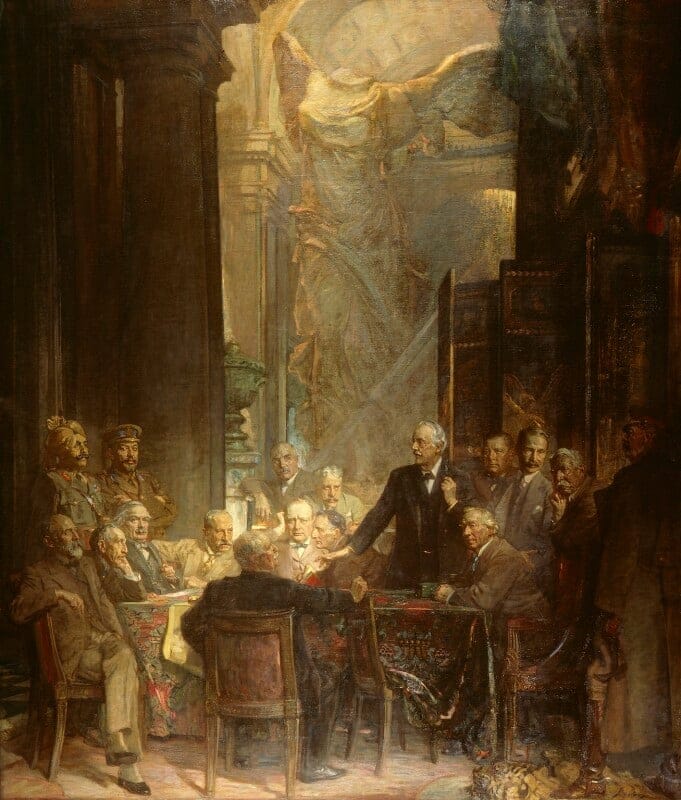
RO: It is called Statesmen of World War I. It was by Sir James Guthrie, who was a Glasgow boy.
It's a very uncharacteristic Glasgow boy type picture. It's a picture of great statesmen who include five UK, British prime ministers and, and a couple of colonial, South Africa, Australia, few generals and so on standing around a table in an imagined scene of a real room in Versailles.
There's Bonar Law, there's Lloyd George. But in the middle of the picture and staring out from you with his great blue eyes and surrounded, his head surrounded by an aura of light so that as he walked down, down the vaulted corridor of the National Portrait Gallery where it used to hang. You walk straight into the eyes of Churchill. There was Churchill in the middle of this picture. And it's an incredibly prescient picture because Churchill then was 14 years away from becoming prime minister.
JS: Of course, our current prime minister has been referenced recently as “not being like Churchill”.
RO: Not many of us can be.
JS: What does getting away from it all mean for Richard Oldfield? What, what are your enthusiasms outside of investing?
RO: Living in the country. I'm really a sort of towny who likes living in the country.
JS: And your county is Kent?
RO: Yes. The countryside of Kent and doing things like chain sawing which I do a fair amount of every other weekend. Reading and this history book that I'm trying to write. Skiing I love, and walking. I just walked around five churches in East Sussex around Alfriston, a place associated with the Bloomsbury set. Churches full of modern stuff. It's something to do with being in the diocese of Chichester. which had a Dean called Walter Hussey [1909-1985] and a bishop called George Bell who both in the 1920s and 30s were very kind of innovative and there's a huge John Piper tapestry. https://www.chichestercathedral.org.uk/news/major-2026-exhibition-marking-60-years-john-pipers-iconic-tapestry
There are lots of 20th century pictures and even 21st century things. In the churches there are modern stained glass and modern things so you feel these are living places whereas most churches are sort of stopped and dead.
JS: Your book is underway and do you have a target completion date?
RO: End of June.
JS: End of June?
RO: Which is a problem.