The World's Smallest Festival - part 1
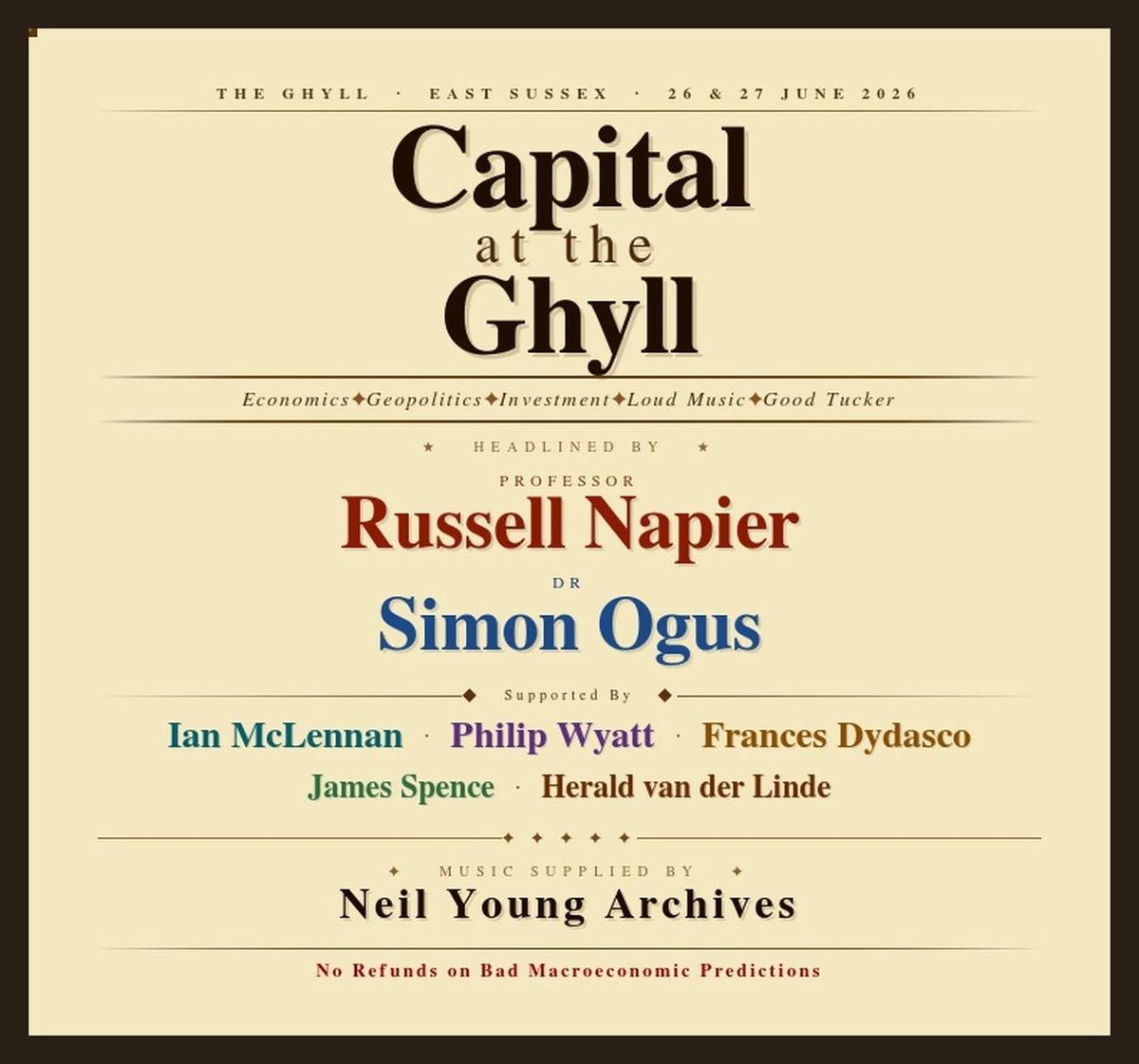
Earlier this summer, friends Ian and Catriona Mclennan hosted a get together at the home in East Sussex. The source matter of the conversation was global markets, economies and politics. We, somewhat presumptiously, titled the gathering as 'Capital at the Ghyll' after the name of their house.
The initial impetus was a casual invite made by me to the author, stock market historian and founder of The Library of Mistakes, Russell Napier, if he wished to attend what I dubbed "The World's Smallest Festival". It speaks to Russell's all round amaibility that, after an Irish chuckle, he said yes.
A festival is nothing without music so I wrote a letter to Neil Young asking if we could access his music. He too was supportive and sent a genial reply, directing me to the Neil Young Archives.
Host Ian Mclennan was head of Asian Equity Strategy at and laterly, co-head of Global Equity Strategy at UBS before working at Brevan Howard and more recently as a director of the alternative asset manager Triple Point. We brought the Singapore based fund manager, Frances Dydasco (formerly of T. Rowe Price and her own firm Proa), out of retirement, hunted down the economists Phil Wyatt and Simon Ogus (formerly Head of Asian Macroeconomics at Swiss Bank and now running his own private consultancy The Dismal Science Group) and and borrowed some time off the busy Asian strategist and author Herald van der Linde (now with HSBC). At different points, all these people's professional lives have interacted so the debate had an informal feel to it.
What follows is a transcript of the first part of the conversation that took place between Simon Ogus (SO), Ian Mclennan (IM), Frances Dydasco (FD), Philip Wyatt (PW) and myself (JS). Russell Napier and Herald van der Linde joined for the second day and the conversation that they took part in will be published shortly as a part 2.
JS: Frances, what is the biggest investment issue right now? If somebody asked you "I have a million dollars to invest sometime over the next 12 months," what would you say to them?
FD: It just feels overvalued still. We really haven't had too much of a correction, at least not in Singapore. The currency has been very strong, obviously. It still feels that everything is inflated to me. I'm not speaking for somebody who's sitting in front of screens, but that's just generally how I feel.
I also feel that we've just been through an inflection point in so many different ways that it's difficult for me to understand and have a framework. For example, once upon a time we would have looked at some form of discounted cash flow, or some form of equity discount rate. But I don't really know what that should be now.
Inflation is just starting to kick in. My coffee prices just went up. My laptop, which I bought in advance, went up twenty five percent today, I believe. Asset prices, I think, in that kind of environment are going to struggle. There's no liquidity. There's money to buy if you know the transactions.
The other thing is, if I think forward, if you asked me that for million dollars, I'd say that actually I think the most interesting opportunity is going to be in arbitrage. What I mean by that is, you used to be able to do all your oil transactions in one currency, dollars. Now you're going to be doing it in yuan, in rials, and I think there's going to be a lot of cross trade opportunities as well, as the whole world moves from one or two major currencies to being very afraid of the dollar, because of what the US might do with your dollars, and not wanting to put it in yuan, or not being able to put it in yuan, which is I think where many ordinary people looking at China's ascent would want to put it.
I think there's going to be some interesting opportunities in that. All of these regulations and restrictions have created a massive market for tax, currency and tariff arbitrage. I have a friend who does this, and he makes a killing doing it. He moves cargo from one jurisdiction to another, arranges the logistics, and often sells it back to another place, taking advantage of different discounts. That's the area that strikes me, and I think he's looking for capital, actually. I think he's making a return on capital in the thirties. So all of these are unlisted things. That's where most of the opportunity is going to be. It's not going to be easy in the public markets, it's going to be in private businesses, particularly anything that does some form of arbitrage of regulation and currencies, et cetera.
JS: Your reference to real estate was about Singapore real estate, right? That's obviously similar to the UK, although in the UK we tend to think it's because of UK specifics like political uncertainty, and interest rates. In Singapore, isn't there a 60% tax on foreign buyers, and they were raiding some of the Chinese money so that, rather like in Hong Kong, that disappeared.
FD: This is true in most countries, I think. And why is that? It's because people like us, older people, have a lot of property, and younger people don't. This is a big problem. It's quite funny, we're separately talking about the Singapore economy and how it moves on property. The Singapore government wants people to upgrade their property because it creates economic activity, that's part of the plan. But how do you do it at these prices? Prices are so high already, and a large swathe of people have so much of their savings in it.
It's a problem. Because money has been so cheap for so long, it's driven up prices, and quite a lot of people, the rich basically, have more than one property, and other people cannot afford to buy properties, especially young people. I don't see how this is going to resolve itself. I don't think supply is the answer. I think it's just fundamentally that assets, as a percentage, are too high. How many countries can you think of where property was, as a metric, at five to seven times annual income?
JS: Rory Sutherland, the deputy chair of Ogilvy, who's a catherine wheel of ideas, makes this same point. His anecdote is that when his parents bought their house, the white goods and furnishings they put in it were something like 50% of the value of the house. That ratio is now 97% land and property value, 3% white goods. He posits that as the major problem faced by most societies. You do see it through the voting intentions, or lack of them, or the apathy or despair of young people.
What is the long cycle historical corrective measure?
FD: The thing is, it's not just housing. Think about what has happened in the United States specifically, which has been exported to the UK certainly, and maybe to Europe, and in part to places like Japan. It's just this unbelievable focus on financialisation. You've had so many years where the financial sector and leverage, implicitly, has been driving the system and driving up the economy. That's why you see such a concentration of wealth in anything to do with financialisation, whether it's Elon Musk or people who own shares in the stock market and people who don't.
You had so many years where you had a lot of growth, but the job growth was very limited, it was not spread out evenly, and wage growth was not spread out evenly, and it just feels like it's become the financialisation. I started looking at ratios to try to measure it, whether it's market cap to GDP numbers or the amount of aggregate debt. Some of it is private, so I've only got a little of it here.
These are just random thoughts I've been thinking about, and it just feels like the pendulum has swung this way, and we are about to swing back. But to what, I don't know. I just feel we're in the excess of a lot of things. If we go back in history, to the Greek philosophers or the Confucian philosophers, they all talk about excessive rates of inequality leading to societal upheaval. It's a nasty cycle.
SO: You look at the Bible, and they talk about fifty-year jubilee years. The Japanese had something called tokusei, which again is a reset of all debts. Then in more modern history, Engels wrote "The Condition of the Working Class in England" in about 1840, and he was convinced that the communist revolution was going to come to England first. He was right that it came to other parts of Europe and Russia, but it didn't come to England because the elites were able to get ahead of the game. At the same time, you had people like John Stuart Mill and Robert Owen, a lot of Scots, actually, it was a social reform movement, a bit earlier, the Wedgwoods, the Cadburys, these sorts of people.
If you have an enlightened elite who are able to get ahead of these problems, and it's a lot easier to do if you're not in a democracy, and there was only a limited franchise at that time. Teddy Roosevelt would be another example, at the beginning of the Twentieth century, with the anti-trust, anti-robber baron stuff. You can get ahead of these problems, but it does involve redistribution, and the question is whether it's voluntary redistribution or forcible redistribution.
I can see a mechanism within societies where 'the bank of mum and dad' can be tapped to redistribute to younger people, but that only helps if you've got rich parents.
So what is actually a broader societal approach to that? Some of it may be building more affordable housing, some of it may be more aggressive taxation on property. I think every country is going to have to answer this, but societies seem to be so fractured at the moment that I don't see us being able to pull this off in a peaceful, voluntary way.
Maybe somewhere like Japan can do it, or some of the Scandinavian countries where you have more consensual societies, maybe Singapore. But in the current febrile environment in the UK or the US, this is why you get people like the New York mayor, Mamdani. If they actually tried to put some of these things into place, the bond markets would go crazy, and that's where I agree with Russell Napier that you can't do it in a free market environment, otherwise financialisation starts to fall apart. Maybe you just have to suspend the free market, but who then is the arbiter of when it gets suspended?
IM: One of the things we can talk about maybe later is the difference between the current capex boom in AI and the 2000 internet bubble that you alluded to, James. One of the things that stands out as a difference is that the macro environment is different, inequality has got even worse. If you look at profit share of GDP and wage share of GDP, profits have been making ever new highs, and wage share is making ever new lows. When you had the internet bubble, the man on the street had five good years of real wage growth. In the last five years it's been the opposite.
FD: Ian, are you talking about the UK or the US?
IM: I'm talking about the US, because that's where it's fastest to get the data. In the five years up to the 2000 market top, the US had had good real wage growth, there had been some redistribution of productivity growth, although inequality was already increasing at that time. That showed up in the consumer confidence surveys being extremely strong, the same as the stock market. This time we've had this incredible business euphoria about particular areas like AI, data centres, space, venture capital, but consumer confidence surveys are on the floor. It's probably not unrelated that people have seen real incomes decline. You mentioned the New York mayor, Simon, but arguably the man on the street had his first go at revolting, and that was voting in Trump, wasn't it? But of course Trump is very much aligned with the new business oligarchs, so they've become aligned with him. So that hasn't worked. Do they go the other way, to the left?
FD: The US system is so corrupt, it's so driven by money. You're starting to see the pushback on it now. If you watch a lot of the punditry to get a gauge of what a lot of these influencers are saying, the MAGA side has turned against the Republican Party, and I think the big push now is against money in politics. You see politicians now having to declare if they take money specifically from AIPAC (American Israel Public Affairs Committee), and it's raising the curtain on how many politicians have been totally bought. It's really quite disgusting. I think Thomas Massie [R – Kentucky] was really the only congressman who hasn't been bought. There's another organisation that gives a red card to people who've taken excessive amounts of money, it's insane. Someone like Susan Collins [R- Maine], who I used to think was quite moderate, I think something like a third of the money she takes is from AIPAC, and it's not a small amount of money.
But frankly, it's a lot of billionaires. The peaceable change that you talk about, Simon, I don't see how these people are going to give up this power willingly. Do you see Elon going, "Yeah, come on guys, have a couple of trillion off me"? I can't see it.
Speaking of profit share, Ian, the number of companies that don't pay any tax is astonishing in the US, not just a low rate, we know the taxation rates in the US are already low, but an astonishing number of the top 500 companies actually pay zero tax.
SO: Are you a US citizen, Frances?
FD: Yes. I could have escaped when you and I were colleagues, but I didn't have the courage to do it at that time. By the time I got the courage it was too financially painful to do, so I can't escape, it's too expensive to give up my citizenship.
SO: So Frances, I hear a lot of outrage from you, and from lots of people. But equally, I also remember just how awful things were in the 1970s. We're nowhere near as bad as that. Actually life for most people is better than it would have been in the 60s and 70s. So I'm just not sure. People flirt with a Mamdani, or they flirt with a Trump or a Farage, who was also caught taking 5 million from Chris Harborne the other day. But there's nobody actually selling a vision of how you sort out these problems. So my feeling is that things actually have to get worse, in terms of needing a market rebellion, or needing someone like Mamdani, or Polanski, to actually give it a go at a national level.
Maybe Andy Burnham is going to be that person. We saw that mini rebellion with Truss, that was just an echo, the first skirmish. I just don't feel things are painful enough. The welfare systems aren't as robust in America, they're pretty generous in the UK and in Europe. There are people who are homeless, obviously, there always has been, but a lot of that's drug related, it seems.
FD: I listen to a variety of people, and the anger level is high.
IM: What's your favourite daytime TV show, Frances?
FD: Believe it or not, I watch Tucker Carlson. His show is interesting, and what he's saying is interesting, to see how people on that side are thinking. I'm generally more centrist, but it's interesting listening to some former Democrats who've also gone off. The number of independents is really growing, but both sides are very frustrated because there's no alternative. The refrain I keep hearing is money politics, money politics, frustration with money politics. I don't think there's going to be a rebellion on the street, but I think in the US especially it's such a militarised society. What do you term civil unrest? I sort of think civil war, but I think it's actually much more day to day and symptomatic than that. It's just disorder, not the kind of crazy riots where stuff gets destroyed, it's a lot of crime, people just taking your watch, like can happen in London. But that sort of level of societal unrest...
SO: The crime rates are falling, actually, crime rates are meaningfully lower everywhere than they were in the 70s. It's a much safer society. The murder rate too, maybe the second differential has moved a little. When people are sitting in Asia and you hear, "Oh, London's a hell hole." It's all gone, it's bollocks. I didn't have my phone snatched in the 1970s because I didn't have a phone, but I was much more likely to be stabbed in those days. If I was in New York at that time, it was just as dangerous. I think people have selective nostalgia.
FD: So you're much more sanguine that basically people will take the financial repression?
SO: No, I'm not sanguine about it. I'm saying that things have to get a lot worse before...
IM: We need a recession or something, to get a reaction.
SO: Yes, and that goes back to your opening point on markets, which is that while the stock market keeps going up, and while the financialisation game keeps going, while the bond markets continue to play along and say inflation is only 2.5%, or whatever, the music can still play. Then you have some of these tech titans talking about... We saw it in Korea, didn't we, Samsung gave a big dividend to the workers. I think maybe that's something we could see more of. But that doesn't help you if you're not working for one of those companies.
IM: They were forced to, weren't they, by the unions, because they're making 80% gross margins, and those workers stopped production.
JS: The workers are financially literate, so they could see how much the corporation was making.
SO: But that doesn't help the people who work at SMEs. And so the gap between Samsung workers, who are already paid better, they actually hate what's happening.
JS: I can't think of another analogue to Samsung, in terms of a big economy with one single massive employer. When you graduate in South Korea, you're either going to work for Samsung or you're doing something else. We think of Samsung as a chip maker, but it's also food, media, advertising. You have to go back quite a long way to think of a comparable, but it's an interesting example.
SO: Some of the US tech people are also talking about dividend paying schemes, creating an account for everybody and putting some shares into it, et cetera. Trump even talked about it.
IM: He talked about the state buying stakes in AI companies.
JS: Yes, and of his many ideas, some are quite well founded. They did take that stake in Intel, which must be showing a huge book profit. They took that stake for a good reason. Have you all read the book "Chip War" by Chris Miller? It's really well done, it came out four years ago. He's a young financial journalist who wrote a brilliant account of the history of microchips, and of that loss of US pre-eminence in the sector, initially to Japan, then Korea.
Just picking up on Simon's point about the stock market going up, I find this difficult, for one thing because, as you said, Frances, valuations are of course not universally high, and Ian wouldn't call himself a value investor, but he's motivated by value. The general growth picture doesn't seem that conducive. If you take it down to the sector or company level, of course certain sectors and sub sectors can do better than the whole, that's always the case. But I think, if the reason markets at the index level have been going up is to do with AI, then, Ian and I have been batting this around for a few months, we don't see the wheels of that continuing. The cracks are already beginning to show, either because of competing Chinese models, or because these things are incredibly difficult to build a moat around.
When ChatGPT was released, that was the first thing I said to my investment team, I don't see how you can build an economic moat around these models, because, as somebody said in an article I read last night, they're just rows of digits, they're not hardware. It doesn't even take much for somebody to hop from one outfit to another. And there's the SpaceX IPO, we've all taken a look at aspects of that. Who's our favourite cynical commentator on YouTube, Frances, the Irish gentleman?
FD: Patrick Boyle. He's very good. If I look at it very simplistically, if you think about the great Google, or whatever it's called now, Alphabet, Meta, Microsoft, what was it about these companies? Extremely high ROCE, extremely light on capital, very light on the balance sheet, basically no physical capital, high cash flow generation. This is the opposite of all three. It doesn't generate cash flow, it doesn't have any return right now, and I find it very difficult to understand how they will, and it's extremely capital intensive.
IM: And they're competing with each other, to an extent, for the first time. Not entirely for the first time, because you've had the cloud computing businesses before, but there's more competition between the "Mag 7" type players than there was before, because they've each had their own dominant oligopoly, or monopoly, that was the cash generator. But in this area there is some competition.
SO: And then you've also got the transnational element, the Chinese are distilling. There was a piece in the FT about Zhipu AI, I think it was, distilling. And then Anthropic last week complained that Alibaba had distilled their data. They were quite happy to rip off everybody's publications without paying royalties.
FD: And the fourth thing that's also very important is that this is no longer a zero cost of capital environment. I think about Anthropic, and I think of Amazon. Think about Amazon in the early days, what did they start with, books. They made money on it, they moved on to something else, eventually they got to cloud and made some money. But the market was so forgiving for so long, they made losses, they kept investing, and until they hit the cloud the market was perfectly happy to let them make no money, because the cost of capital was zero.
JS: Even with Amazon though, Frances, there was a brutal bear market for several years in the early noughties, but it survived. The share price went down 90%, that's the number I remember. But it survived long enough to get to a size where it could keep on keeping up.
IM: But you're picking the winner there, Frances. So many of them went bust. And Amazon survived, presumably not just with a better business model, but a better balance sheet going into the downturn.
PW: At the last dotcom crash, which is the only comparable cycle you've seen before, what's the conclusion so far, are we in a mania?
IM: Well, probably. But I'm going to try something positive about AI. I think the capex boom is too big, the valuations are too big, the optimism is too high, but it is a bloody useful tool.
The more it can help with the development of itself, and I would have thought one of the main priorities now is to make itself cheaper, because at the moment it's taking up far too much resource for what is essentially a software product, as you suggested with your zeros and ones, James. But ultimately I do think it will give a bit of a boost to customers in terms of productivity, as people learn how to use it more efficiently. We can discuss whether we think it's going to create widespread job losses, but do the customers of AI actually get any productivity growth?
Thinking about countries as companies, does it really matter if you're not involved in developing it and owning the models, as long as AI is actually pretty useful?
JS: That's been my point for five years. I said, look downstream, because the market's just focused on investing in the people building the models. But actually you flip it on its head, and you look at the least efficient organisations, and you see them deploy AI. And I could be wrong in this very general summary, correct me if I am, but in China the focus is not on achieving AGI, but on making AI work, particularly at the physical interface. As somebody said to me the other day, we don't need one great model that allows Demis Hassabis and Dario Amodei to ponder grand questions, we need a lot of smaller models that are cheaper to run and help with distinct design and build challenges.
SO: As a business owner, my feeling is that people of our demographic, who know how to ask the right questions and know how to call bullshit once the thing has spat out an answer, can benefit immensely from AI. But it probably means we need to hire fewer people than we would have in the past. As you rightly said about AI in processes, and embedding it with robotics, Ian knows much more about this than I do, but there's a real debate in China about this actually creating even more joblessness, in an economy where migrant workers are having to go home anyway because the construction boom has come to an end.
Going back to our earlier policy debate, I think the road ends up in universal basic income, but then how do you pay for it? Does it actually accelerate the mental health crisis, because it's all well and good getting fifty quid a month just sitting on your backside all day, but a lot of people won't be particularly happy with that. So I think the productivity argument is correct, but it goes back to Frances' opening point on distribution. Those productivity gains will be very unevenly distributed, I believe, and will actually exacerbate inequality within societies, and probably benefit us older people more than the younger generation.
FD: Going back to the productivity point, I don't think, at least in the way the United States has built this out, that it's a foregone conclusion that the US will achieve economies of scale. What I can see is the data build out, and the very rapid obsolescence of the physical plant and equipment, and the fact that they're not charging for things like water. There's a paper I can circulate later, it's not actually clear, we assume technology follows Moore's Law, basically economies of scale, you get higher efficiency over time. But today it's not clear that, at least the way the United States is deploying AI, there will be economies of scale. In fact it looks like there are diseconomies of scale.
If you look at the losses released in the pre filings for OpenAI’s IPO, the loss per user is so large that I'm not sure, if they were actually to charge an economic price to cover the capex and generate cash flow, that it would be productivity enhancing at the current configuration. I'm not saying this isn't going to change, because I think the capital investment configuration can certainly become a lot more efficient.
One of the most interesting comments I read on this whole capex issue was that AI takes a perfectly good unit of energy and wastes seventy percent of it. Seventy percent of it goes into waste heat, which then has to be cooled, which requires energy. And most of these data centres, if you look at the configuration, aren't planning much redundancy, they're planning ten percent redundancy, which is too low.
I think that rate of breakdown is going to be faster than people think. Even so, subsidies are so large right now that I'm not sure we've hit the rate at which the elasticity kicks in, when you actually charge an economic price. Because right now there are no economies of scale.
JS: On that, if I can add to it, what's been obvious to me this year is that adoption was the key approach for Gemini, ChatGPT and Claude. In the past few months they've changed to try to build more profitability. First they were looking for usage and customers, now they've changed the metric, less price per seat, more price per token. They're caught in this bind because their business logic tells them they want to dominate, and nobody has achieved domination, although ChatGPT had pretty much the whole market for a couple of years. But now they want to raise equity capital, so they want to show a cleaner path to profitability. Then you've got the Chinese models, which are always going to be cheaper, or are cheaper for now.
IM: The one Simon referenced last week is free to download at the moment.
SO: Yes, they're good enough. I run the Alibaba one, Qwen, on my China phone, and I run a Western model on my other phone, and I compare them. For day-to-day stuff the Chinese model is good enough. Phil, you probably know them better than I do.
PW: Frances' point is that, if you talk about it from a consumer point of view, then I agree, Simon, the consumer gets more for less, up to a certain point of token value. But at the moment it seems to be a bit of a, I hesitate to use the word, subsidy in the system, provided by somebody's future profits, because everyone's fighting for usage. From a production point of view, I agree, Frances, there's a lot of wastage, and the engineering companies are trying their best to spend less energy and charge the same price. But I think this transition period is probably going to be quite long, and it could involve a lot of gearing up. One of the issues is that you end up with more money raised leading to more token generation and more energy generation, and it's not yet clear what the business model is for some of these companies in the longer term, because the race at the moment is to get as many users as possible.
FD: Did you see the subsidy number though? The subsidy per user was so crazy that at that rate their IPO would only cover a fraction of a year's worth of losses. It's an insane amount of money they're losing. Same with SpaceX. And Anthropic's losses are even bigger, because its subsidy is even bigger. That's why they started to increase the price through the token rate. The number I've seen that would be required to close that per user loss would increase the price exponentially, not one or two times, more like ten or fifteen or a hundred times, because the subsidies they're giving are completely unsustainable, the losses are so massive. That's why SpaceX went and did an IPO, they only sold 4% of their shares, and immediately did a massive bond issue, and it doesn't even cover their committed capex, meaning what they've already signed contracts on, by a long shot. They have to raise so much more money, a hundred billion dollars in the last month alone.
Their committed capex is 284 billion or something like that, and they've only raised, what was the IPO, 85 billion, plus a 30 billion dollar bond issue recently. So they've raised about 110, 115 billion. Forget about meeting the projections, when their addressable market was said to be larger than the entire US economy, which was hilarious.
IM: Just to be devil's advocate, clearly I don't disagree that the waste of resource from large language models has become ridiculous, it cannot go on. It will go on as long as there's the capital to do it, as long as they're subsidising it.
FD: As long as they're effectively giving it away almost free. But at the rate they're losing money...
IM: At the end of this chain are Anthropic and OpenAI in the States, which at this point are still unlisted companies and have been able to raise colossal amounts of money to keep going. Anthropic has raised 105 billion dollars in the last six months, as a venture backed business. At some point you'd imagine that can't keep going on, but it's possible to believe that and still think there can be a lot of productivity growth from whatever the ultimately successful AI models are, hopefully much more resource efficient. If you've got really advanced AI models, presumably you're training them on how to make the next model more energy efficient, and more memory chip efficient.
SO: Recursive self-improvement.
IM: Yes, it's a physical constraint, this is about physics, not weights, as somebody put it. But it's possible to think that and still think there is productivity growth for companies, and therefore potentially countries, that might come from this.
FD: But what I'm trying to say is that between now and then, my guess is we're going to have massive stranded assets out there that are built.
IM: I don't think they can keep raising this kind of money indefinitely, there are some companies in the States involved in this that don't have huge balance sheets. But the likes of SpaceX, Microsoft, Alphabet will be able to get through this with the write downs that we pessimists implicitly expect them to have, eventually, rather than what happened in 2000, with all the telecoms companies going bust.
One thing to say to you, Simon, at the macro level, you mentioned the negative part of AI productivity, that older people like us benefit from it but younger people lose their jobs. But still, going through that process, we should get the benefit of some national productivity growth, shouldn't we? We can't go straight from that to, "Oh my God, it's a recession." Don't we get some productivity growth first?
SO: No, I think, as I said, it's productivity enhancing at the macro level for the users, not, as Frances says, the operators. Just as the railways back in the day were productivity enhancing for everybody else, except if you owned the railway companies.
They went bust, the American railways went broke, the government bailed them out. Barings went bust for the first time because one of the US railway companies, I think it was actually an Argentinian railway company, defaulted. So, I think it is productivity enhancing, but the fiscal response, or the market's bond yield response, will determine how long lasting that can be. You can really undermine confidence. Frances, I want to go back to your earlier point, on the demand side for the products, even at current prices, wasn't there a company that announced it had burnt through its entire budget?
JS: That was Uber.
SO: In the first half of the year. Now they're rationing tokens, and others are all raising prices effectively, from what I can see.
FD: Effectively they're raising prices because they can't keep losing this kind of money.
SO: But if demand is elastic, as it sounds like it already is, raising prices isn't going to help you very much.
FD: Exactly. There have been some interesting examples. One of the big companies encouraged their employees to use it, and they actually had to cap the monthly spend, because when they let their employees loose, the bill was insane, so they had to cap it. There's a piece I should have pulled up, that said one employee spent something like $900,000, some crazy number, and got cut off. But essentially, from what I'm reading, at a more economic rate it isn't a clear cut substitution for people, because it depends on what the actual rate is set at.
Up to a certain rate I think banks will have young people doing this. Especially, someone testing AI for accounting said one of the interesting things is that they did a series of tests, if you have an analyst and the first time you ask him to build a model, he has to figure out how to use Excel, so it takes ten hours. The second time he kind of knows how to use Excel, it takes five hours. But when they did the same test on AI, it didn't turn out that way, AI didn't learn from its mistakes, it actually took longer the second time because it effectively forgot and redid it. There are issues, and I know these are teething issues, a lot of this will get sorted out.
SO: But I think there's a quantitative versus qualitative issue here. If you're talking about certain models, James knows that my company is actually entering into a joint venture with an AI company, and they're going to automate a lot of our processes. But we don't see any way you can get away with how you actually build the foundational models in the first instance, and check the integrity of the data, that's still going to have to be done, and maybe that means I still need to employ someone who's good with data and can do that. But if I'm a lawyer, or a law firm, basically a paralegal or an articled clerk putting together case studies, that stuff can be automated, the qualitative stuff is pretty easy to do. The share prices of Indian outsourcing companies are down, what, 40, 50% over the last year, those companies, or the Philippine model, I see real vulnerabilities there. Going back to the history of this, in Dickens' day, rich people used to pay for their kids to be articled as a clerk with a lawyer or an underwriter. We have something similar with the "trustafarians" these days getting internships at Goldman Sachs, but if there are fewer of these actual internships available, what does that mean if you don't have rich parents? So again, the productivity gain may be in the macro numbers more immediately, but I do worry about the political reaction, it doesn't fix the inequality.
IM: It might help the fiscal position a bit, though. But it doesn't help the inequality.
SO: But then how do you actually distribute the fiscal benefit? Part of the answer would be to use fiscal policy to deal with the inequality, I suppose, universal basic income.
FD: By the way, on the railway analogy, I don't think it applies here, because the obsolescence rate is very high with technology. It's not like a railway, where you put the thing in and can still use it for a hundred years. That's one of the differences. So if it becomes a dud asset...
SO: Fair point, but the issue is always whether it's bank financed or equity financed.
FD: Both tech booms so far have been largely equity financed. But now that's changing, JP Morgan got involved. Why did JP Morgan and Goldman Sachs put their names on the SpaceX IPO? I think they did so to get loans paid back, and I don't think they got all of it paid back. But we're at a relatively early stage in that cycle, it could get, if we go into a massive debt cycle in the next few years, this could keep the game on the road for quite a while, if the markets allow it.
Do you know what, though, Simon? Who's going to bail it out? Social Security and IRA money. If it's debt, it will be us. If it's equity...
IM: Broadcom partially guaranteed a 35 billion dollar loan to back data centres for Anthropic. Broadcom, the chip company.
JS: That's the round tripping that's been taking place, vendor financing. There have been other features of that, but that sort of thing has been quite unusual until now. You're edging towards suggesting that countries like the UK, that don't have a leading model, might be the best place to be. Picking up on that point about India, people I know in Mumbai have been incandescent about how Infosys and that cadre of companies have just slept walked through the whole thing. In share price terms, you just referenced how the markets have taken it.
PW: It's a challenge to come up with a counter argument, I can only come up with discussion points to counter all of that. One is that the usage of AI varies from industry to industry, it's not homogenous. The AI used by SpaceX, for instance, would get melded in with its other assets, the telecoms and satellites they're going to cover the earth with. So it would morph into either a boring telecom utility with a small space add on, or something more similar to a huge defence contractor with a telecom subscription base.
In that situation, if things go belly up, they've got hard assets. To Frances' point, what assets you're left with matters, because it's more of a utility type setup. But if you look at software, to Simon's point, these big companies have legal software, all different sorts of software, modelling software, and they'll run it for you, just like Microsoft does for big institutions. One argument might be that all the people who used to run the software for the bank, the analysts and so on, will simply have a kind of shadow worker double at one of the big SaaS companies, which will just grow and grow, because they're the people who will need to create the models and keep them maintained and upgraded over and over.
So this transition phase is very messy, but it depends quite a bit on whether, if you get into a conversation where lower rates at some point fuel a lot more debt borrowing in this area and inflate the whole thing further, once it collapses, or there's a great consolidation at a lower stock price, there'll be a new transition. I'm not 100% convinced about the idea of 90% unemployment and the need for a huge universal income, because firstly I don't think governments can afford it, and secondly it's not a homogenous application of the changing technology to begin with. I think industries that are a bit more utility like will be able to handle it better than those where you see no more analyst recruitment, but instead all that work is outsourced.
FD: You know, guys, I've spent my entire professional life as a bottom-up investor, and I have to say, listening to everything I've listened to for the last however many years, every instinct in my body says to go exactly the opposite way. I think the area that's going to be interesting is anything that's physical, atoms not bytes. That's where I think there's money to be had, because that area still has inefficiency, you still need to do it with people.
SO: To your point about physical assets, I know a shipping family that haven't bought a new ship in about 15 years. But they also have four sons, the patriarch has put them in four different countries, and a lot of the discussion is how you run enough working capital at the family office level to make sure that if things really go wrong, at least two out of four parts of the business survive. It's a family that's been going since the 1850s, starting out in Shanghai, so they've seen a few cycles.
FD: This is where you're going to make money, all these arbitrages. But people have to know what they're doing, they have to have the contacts, they have to know the logistics, they have to be able to move their cargo, currently stored in Madagascar because there's an exemption right now, and if it changes, they'll shift it. Things are moving very fast, so being able to commit to warehousing something for a set number of years is changing so quickly that people are having to be able to move that asset. So they tend to want to buy old things rather than new things, because the environment is changing so quickly that you can't commit to getting your money back over ten years. The typical payback for a warehouse can be even faster because the restrictions keep changing.
IM: Phil, what do you cover at the moment?
PW: I've stuck to Asia, obviously China is a big part of it, a lot of China and North Asia macro research, and India as well, but linking it to the major trades clients or the company can make money out of, whether it's gold or cable or whatever.
IM: What do you make of China right now?
PW: The question is whether China is starting to reflate again after a long period of deflation. I think that's the biggest macro question I'm trying to answer, and my answer is that they've gone from negative to zero. That's been a useful push, they've also been quite generous on the monetary policy side, but it's not an efficient way of distributing it through the fiscal system. That's one piece of the overall nominal puzzle, I've long been wondering whether the nominal anchor is basically stable. I've come to the conclusion that if you think it's basically a three to four percent growth economy, then the numbers seem to stack up, and very mild deflation is what we might be going through. But you can track the property markets to see what's going on there, they're slow, and barely recovering.
I was speaking to Jon Anderson [former Chief Asian Economist for UBS] a couple of weeks ago, in Shanghai, and he said there's a little bit of a green shoots feeling, though people don't like to use the words "green shoots" because they die in the sun too fast. There are only one or two areas doing better, the rest is pretty much still fairly dormant.
But you can still have sizable fluctuations in stock markets, even a few years after 1997, if you take a place like Thailand, there was a rally and it went up and came down again. Japan also had the Nikkei going up and down by fifty percent, quite volatile through ten years of deflation. So you can still get very sizable equity moves, but there's a lot of churn within thematics.
The group I am working with is very bullish on China tech, that's bottom up, it seems marketable, but I don't think it's that investable for the long term. I think the way I'd look at it is in terms of extreme moves in the stock market or in particular sectors, if you see a big dramatic move down because there's been a bottleneck in some components, by all means, you draw wide lines on your chart, it's a trade.
The key thing is whether the whole economy is continuing to descend into quite serious deflation, then it can come back if the micro around the sector makes sense and you can see a way through. It's been difficult for me to promote a sideways trending move, because the China stock market has gone up over the last couple of years, and various theories about whether the authorities would institutionalise a kind of pension fund system have been blown apart, that's clearly not going to happen. So they just look at the S&P sailing upwards and think, "I wish we could have a situation like that here."
FD: Actually, I don't think so. I think they want to see the opposite of that kind of financialisation.
PW: Well, from the point of view of long-term savings, I know what you're saying, and I agree. That's one of the reasons it's quite hard to make money, entrepreneurs find it very difficult to know how large to get before they take the money off the table.
FD: Or it gets slapped down, which is what used to happen in Korea. Every time you make money, the government whacks you down, here comes another competitor, here comes a big tax. I mean, Simon, I think there was some question, an open question to you both on the Korea and Japan situation, the rationalisation or greater efficiency of those stock markets. Whether anyone around the table has any store in that, or whether it's just a flash in the pan.
But whether there is enough meaningful change in the tax and shareholder rights environment in these two places to have a meaningful impact on longer term growth, I have a fifty-fifty view on that. A lot of what's gone on in the Korean move, I don't think, is related to that.
JS: In the case of Japan, it is well installed. Although people talk of corporate reform as being a recent thing in Japan, it actually got going under the Koizumi administration and, at a certain point, it became a self-reinforcing process.
PW: I've been a believer in the Japan story for exactly the same reason as James.
SO: It really started with Koizumi, and there's a learning by doing effect in Japan, whereby, especially as the older generation retire or pass on their businesses, or shut them down, you've got attrition, which is leaving the more efficient companies, and they're realising they can make more money by running the company a bit more efficiently. So I think ROEs [ Return on Equity] have generally improved. Does it move potential growth in Japan, given the demographics are going in the opposite direction? No, it's going to be a very low growth economy.
Korea is a very different market, much thinner, much more talk than delivery. I wrote a paper on this about two years ago, and I was quite bullish on Korea on the demonstration effect, arguing that in Japan after the Second World War, the zaibatsu were taken apart by the Americans and the keiretsu took over, but the keiretsu weren't allowed to own banks.
Whereas in the Korean system it's still much more zaibatsu owned. Park Chung-hee [President of South Korea between 1963-1979] recreated that, because he had been a colonel in the Japanese Imperial Army, a fact not often repeated. The interlocking between the financial system and a much narrower number of heavily family dominated businesses is much stronger in Korea, so it's going to take a lot more carrot and stick to really get the changes. While we've got this AI chip game going on, and given that Korea was cheap and is now only okay on valuation, the game can go on. But if Frances' opening point, this whole AI thing rolling over, comes true, Korea is going down 70% probably again.
Snippet on memory chips, Frances, analysts currently forecast that the three memory chip makers will make 450 billion dollars this year of operating profit.
IM: Samsung, SK Hynix and Micron. That's a big chunk. Obviously not all of that is going into the data centre boom, they go into all sorts of other things as well, but it's become a big chunk of that capex cycle.
SO: Can I go back to our earlier discussion? I wonder about another variable here, your investment profile based on how old you are. I hear exactly what you're saying, Frances, about wanting to invest in private markets, but that's hard work, and given I've got a bus pass at this stage, I took a view about five or six years ago that I wasn't going to do another private deal, because it always takes far too long to get your money back.
FD: No, I am not going to do this. My kids are going to do this. I'm going to fund my kids to do this.
SO: If you've got the bank of mum and dad who are going to do it for the kids, fine, great. But how are ordinary people's kids going to do this? The information asymmetry in the public markets is terrible, in the private markets it's even worse.
FD: This is from my own experience, what I can control. I think one of the things I've been trying to teach is that you need to think about societal benefit, not just shareholder benefit. A business that does well is a business that looks after its customers and its employees, the revenues will come if you look after those other things. If you only think about profit, your business will not last. This is a point I wanted to make about Japan in a second. I'm hoping, and this is maybe a bit of wishful thinking, that if my kids do prove to be entrepreneurial, and they haven't proven that yet, I will only do this if they need growth capital. In lieu of giving them a down payment on a house, I might help with some equity, imagining they might be doing this together.
I'm too tired to run a company again, so what I do is mentor people and back them. I don't really care too much about making that much of a return, I'll be honest, I do it for fun, to keep my brain engaged. Teaching people how to think about a business, how to think about which investment they should prioritise, how to look at the returns on different things, whether we should configure the capital for a bigger site or a smaller one, what the trade-offs are in terms of capital required and flexibility, things like that.
I mentor a couple of businesses that started out, asset management businesses specifically, and I mentor another group who run a Pilates studio, which I funded, and I mentor my kids. I feel my skills are better used mentoring rather than investing, if I can, if it's sensible. But sometimes it's not good to cross that line, it's better just to stick to mentoring. With my kids I will invest, but this isn't in lieu of a business school education, it has to make money or I'm not doing it. Otherwise I'll stick it in the bank and spend it, because I've already told my kids my aim is to die broke, or in debt, leave the debts to the kids. It's not a charity.
That's why the Japanese run their companies with a low ROE. The reason is that they don't run a company for earnings per share year to year, they run it to build terminal value. I studied Japan a lot when I was at T. Rowe. If you look at how Toyota thinks about investment, they'll invest in hydrogen, they'll invest in lithium, and some of these may end up not going anywhere, but they've decided to put the capital down, even if it means it's not going to earn a return, because it guarantees the company has a future. They think of things that way, whether it's the way they fund their supply chain companies. Remember, during Japan's bad years, Toyota was effectively a bank.
-end of Part1-