Simon Ogus interview
Dr Simon Ogus is recognised as one of the best-known macro thinkers in Asia. He has lived in the region for over 35 years, initially working at GT Asset Management with John Greenwood.
Following his departure from SBC Warburg in 1999, post the merger with UBS, he established his own independent macro consultancy. DSG Asia Limited (The Dismal Science Group!) has operated successfully for 26 years, making Simon not just one of the very first analysts to turn fully independent but also the longest standing within Asia.
Simon's clients value him for his insight, candour and ability to translate complex interactions into succinct summaries. He points out in the interview that investors do not need economists 90% of the time and their main utility is in signalling long tail risks. The kind of risks that can materially harm asset values. He has a commendable track record of predicting left-tail severe economic dislocations that resulted in deep bear markets, but also major right-tail turnaround stories.
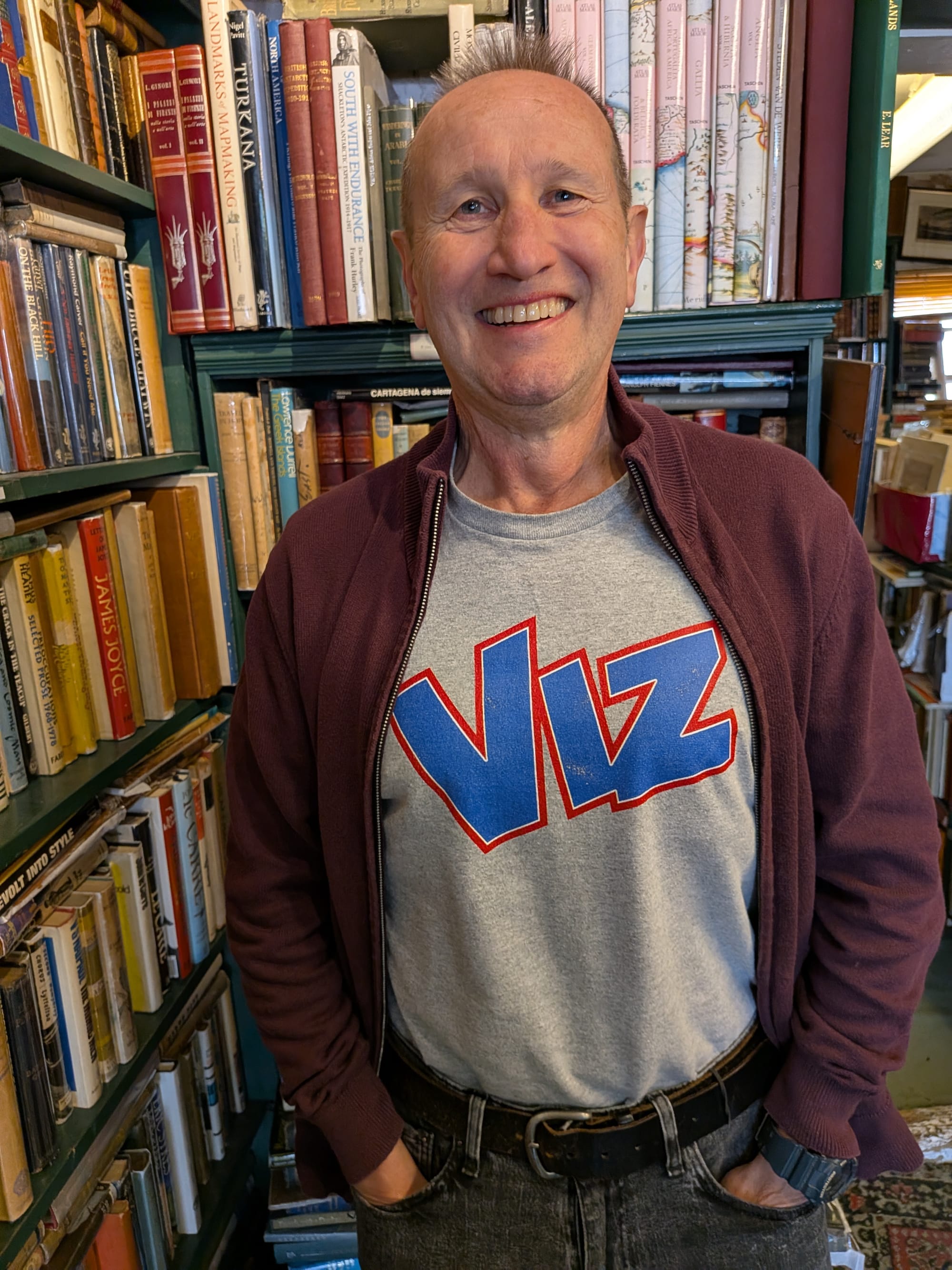
Wrapped around his professional demeanour is a liking for the irreverent and a devious sense of humour which his clients, many of whom have become friends, appreciate. Under that knit sweater lurks a Viz cartoon tee shirt and he cites Viz and Private Eye as two of his favourite sources.
Simon has provided a piece of his recent research to readers of First Shot, accessible via a link at the end of the interview.
JS: You went from school to study a BA in economics and econometrics at the University of Manchester. Talk through that decision.
SO: I went to a local comprehensive in London. In those days, the state system was good, and I was lucky enough to get into university to do economics at Manchester. I chose Manchester because it offered a traditional buffet approach to economics, not as a narrow quantitative field as it has become today, but as part of the broader social sciences: philosophy, economic history, sociology. I was good enough mathematically to get the econometrics part of it as well. When I graduated, I started to train as an actuary, which is where my personality comes from.
JS: What aspect of your personality?
SO: Well, they say that an actuary is someone who is there to make an accountant look charismatic.
I decided after a couple of years that I did not want to be doing that as a full-time career. I was actually working on the pension fund valuation side here in the UK.
So I then transferred back to London to work for a fund management company as a a junior quant and economist grunt. It was a time when Japan had really started to take off.
JS: This is the mid-eighties.
SO: And they did not have anybody that really knew anything about Japan, so they said to me, why don't you go and be our Japan person? It was a great autodidactic process, but you could see that the excesses were building. Even as someone who was wet behind the ears, you could see that things did not make any sense, and returns on capital and valuations were increasingly making less sense as we got to the late eighties.
JS: Did that involve trips to Japan?
SO: Not regularly, no, because I was too junior. But in effect, in the land of the blind, the one-eyed man was king. I decided that I did not want to be stuck when it did go wrong, so that is when I went back to Imperial to do my MSc in Management Finance. And while at Imperial, I decided that I wanted to get out to Asia.
Back in the day, I grew up in London in a very multicultural area. I had lots of Asian friends from the subcontinent and East Asia growing up as a kid, so culturally it was not really a huge leap. The choice was really to go to Hong Kong or to go to Tokyo. Given my priors on Japan, plus the fact that even though anything being offered would probably have been about five times the salary it would have been in London, I still could not afford to live there. I could do the numbers because the bubble was just so excessive. People do not realise just how big the bubble was in general.
JS: Well, I think Jeremy Grantham [co-founder of the asset manager GMO] still often points out it is the Big Kahuna of all the bubbles.
SO: In Tokyo, it was a £5 cup of coffee back in 1989.
JS: When a cup of coffee would have been 50p here.
SO: Hong Kong was the other option. I was very blessed that a gentleman who has been mentioned in your other interviews, John Greenwood, was looking for a replacement to work with him because my predecessor, Tim Lee, was coming back to the UK.
I wrote a cold call letter to John, as we did in those days, and asked for a job. We got on very well. Basically, I graduated from Imperial and was on a plane about a month later out to Hong Kong.
JS: Was the MSc in Finance a relatively new course at Imperial at that stage?
SO: It was a relatively new one and, because of its technical ties, it was seen (by some) as being an equivalent of the MIT course. It was pretty quantitative. I am not a huge believer in quantitative economics, in that I think the mathematisation of the industry has led us down a lot of dead ends, but I could understand the maths to the extent that I could work with it.
JS: Were there any teachers at Imperial that stood out?
SO: The Dean, David Norburn, who unfortunately I have learned has recently passed away. I viewed it as pretty much an in-and-out MBA. In Manchester, you are much more socially engaged because you are an undergraduate and, like many people, spent too much time playing football and drinking. At Imperial, it was very much a means to an end to upgrade my financial market and business management skills. I did not feel any great emotional attachment to it, but it was a very good course. There were some very good lecturers there, and I think it has only developed a stronger reputation today as a business school.
JS: So, it was a great stepping stone. When you had that fork in the road between Japan and Hong Kong, could you sense at some level that the price structure of Japan was going to have a downside to the upside?
SO: As macro guys, our job is to understand where the tail risks are. 90% of the time, you do not need to talk to an economist in markets. Actually, many market people will say 100% of the time you do not need to talk to economists. But when someone like a central banker or a Goldman Sachs person jumps up and says this was a 1-in-10,000-year event, it is generally an arse-covering exercise since these are not 1-in-10,000-year events. Mathematically, it is because they are using the wrong distribution, as most financial models work off normal distributions.
I am simplifying here, but the reality is the world has fat tails, and the skew, especially in the Emerging Market context, means you really want to be well away from the places that are going to blow up, because that can set you back a long way. So the job of a macro guy is to identify a left-tail event, which is what Japan seemed to me at the time: it was really going to blow, and pretty nastily, but also the right tail events where somewhere is about to really take off
I never thought that, 20 years later, Japan would still be dealing with the aftermath of the bubble. The signs were there, as they were in the Asian crisis and various other crises. We know we can identify excesses; we never know quite when it is going to go, so you tend to be early. Equally, on the right tail, meaning a more optimistic upturn, when a country has gone to the IMF and taken the medicine—or Hong Kong had an exogenous shock in 1989 that led to a big price reset—if the economic fundamentals are actually improving and it is, as Schumpeter said the refreshing douche that reinvigorates capitalism, then you want to be full-on bullish. It is not a matter of being a perma-bear or a perma-bull; it is knowing when you have these extremes of the distribution coming through.
JS: When you joined John Greenwood in Hong Kong, what type of shop was GT Asset Management? I remember very well your meeting room that had all these beautifully pinned charts that had all been printed out and pinned up. It was a room covered in charts. Who was there, and what was it like?
SO: That room you remember was called The War Room. GT was one of the very first global emerging market shops, I believe. John himself had gone out to Japan in 1973 as a scholar at the Bank of Japan and had been hired by Richard Thornton and Tom Griffin—the T and the G in this case—to be their macro guy, probably in the late seventies. GT hired a whole cohort of people who went on to set up their own shops and who are still very well known today, such as Hugh Sloane, Christian Wignall, Jim Mellon, Paul Matthews, James Alexandroff and Chris Wood.
The GT alumni network is very vast. I was the generation that came after most of the names above. Because Japan was very prevalent in John's thinking, we maintained macro coverage of Japan out of HK; we were looking at Japan in an Asian context. I always think it is a bit artificial the way people say 'Asia ex-Japan', and now 'Asia ex-China'. In terms of the integration of the region, you cannot really look at one independent of the other. John is a very methodical, carefully thought-out person with a fundamental monetarist structure for looking at things. Manchester tended to be more of a money and banking type of university anyway, so I had leanings towards that strain of analysis. I was not having to intellectually pretend to work with John. He was a delight to work for. Many people in the industry will say he is the godfather of Asian economics and we have all learned a lot from him.
JS: He is still active. He is still writing the International Monetary Monitor. His focus there is monetary aggregates, and he is also one of the teachers on Russell Napier's course.
SO: Correct. When you and I turned up in Asia, most of the macro people out there were storytellers, ex-journalists who were somewhat flexible with the numbers, changing them around to fit the story they wanted to tell. Very few people had applied fundamental economic analysis to the Asian economies and markets at that stage internationally, although there were obviously very good academics and practitioners at the local level in each of these countries.
It was a very intellectually stimulating environment to work in. Our view on tails was that we would identify countries where there was going to be an opening up, liberalisation, or restructuring, and we would go in and do deep-dive research to build big positions. Personally, I led the first-ever international trip for a macro person with one of my management colleagues to Pakistan in the early nineties when it first started opening. We did the same for India a year or so later, and Indonesia in the late eighties.
There were turnarounds in Asia and similar periods to the Thatcherite Revolution, with Hawke and Keating in Australia, and Roger Douglas in New Zealand. You also had China. Following the Japanese bubble deflating, China was gradually getting its act together by the mid-nineties. They had gone through a number of hiccups, both economically and socially, but Zhu Rongji cleaning up the banks and setting the currency at a more market-oriented rate changed the dynamics. It was a fascinating time to be learning your trade because I was still very young then.

JS: What is not often appreciated is that when we began working in Asia at our respective shops, not all the markets were open. The cap focus within Asia changed tremendously over 20 years. Talk through the investible universe when you arrived in Hong Kong and the opening of various markets.
SO: If it was Asia Pacific, it was Japan, Australia, and New Zealand as the developed markets. It was Hong Kong and Malaysia as the main other two markets. Singapore, rather like today, was still a bit of a rump market. It has never been a particularly dynamic equity capital market, although there were obviously the banks knocking around. Then the Philippines, Thailand, and Indonesia were more investable, so ASEAN was much more important. China was not open; it did not get a stock market until 1992. India, Korea, and Taiwan were closed. You could buy closed-end funds in these places, but it was very limited.
With Korea, Taiwan, China, and India basically off the menu, you were meaningfully underestimating the GDP weights or the economic weights in the region, and overweighting the ASEAN elements. That had a heavy contribution to creating the bubble which unfortunately unwound rather painfully in 1997.
JS: There was a tourism aspect to our jobs in that Western fund managers treasured the fact they could come to Asia once or twice a year, meet people like ourselves, visit these countries, and eat spicy food. My role when I was in Jakarta certainly involved a lot of tourism organiser aspects to it.
SO: GT also stood for 'Good Times Management' internally. It is something I still do today; I think there is nothing you can substitute for actually going down to a country for three or four days and meeting people on the ground including companies. Even though I am a macro guy, I have always wanted to see companies. I often travel with a fund manager or a client, doing a mixture of macro and micro meetings, talking to journalists, academics, other people on the ground, going out for dinners in Jakarta, and so forth. It is a great way of gaining colour. Although I travel less for business than I used to—partly because video technology is so much better and COVID reduced the need to show up in the States two or three times a year—my company still has a pretty big travel budget for regional travel. It is part enjoyment, but it is also about how you keep yourself up to date and relevant in these places.
JS: You left GT to take on a really significant role at Swiss Bank that became UBS. Talk about the doctorate you undertook at that time.
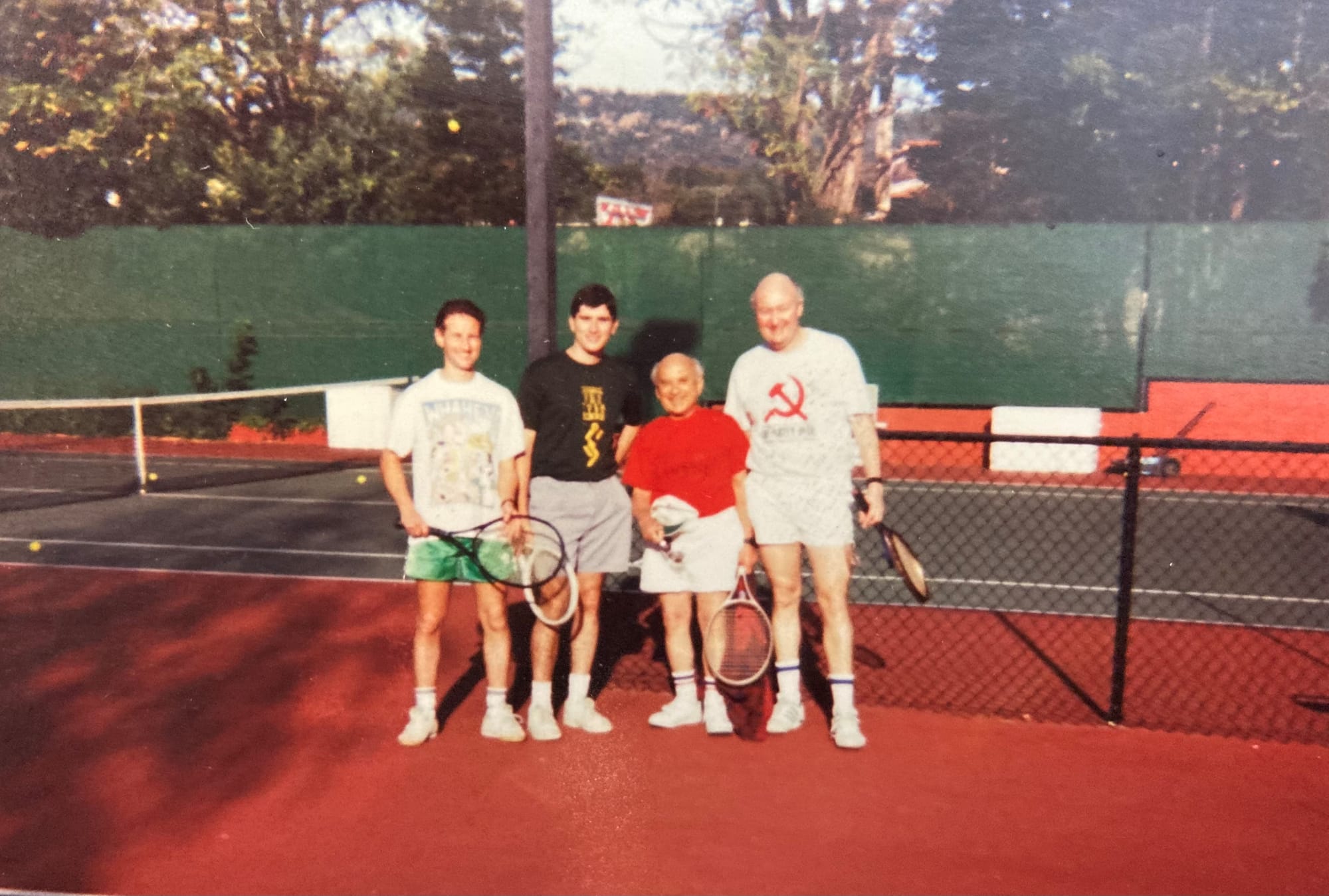
SO: That is an interesting phenomenon. John Greenwood was very much involved in the Asian work that went into the initial iterations of the Economic Freedom project, the stuff that the Fraser Institute and Heritage Foundation do. As his grunt, he got me to do a lot of the numbers to see whether we could incorporate the Asian economies into these free-market, US ideas of what constituted economic freedom. This initially involved sending out written surveys. The reason I give you that preamble is that, as a result, we were invited to present our results at a conference in Sonoma. That was really hard [to go to Sonoma], as you would imagine, because we had to sit in a nice vineyard with people like Douglass North and Milton Friedman. I have a picture of myself and Milton Friedman playing tennis.
JS: And what was his game like?
SO: He was very funny, actually. He was a very generous, polite man who was really nice to young people. We got on the courts—he must have been about 80 by that stage—and he said, "I am a free marketeer, you are not allowed to go easy." We played doubles, and it was a great formula. Anyway, I was at this symposium with all these huge brains, and I was thinking that there are some culturally deterministic biases in the way this is being set up. Elements of these freedom indexes were not necessarily fully applicable to Asia or needed to be tweaked. It got me thinking about whether there was an alternative paper that could come out of this.
Because my Master's was from London University at Imperial, you had the external PhD programme. If you put a proposal into the university system and any of the professors thought it was a worthwhile thesis, they could volunteer to be your referee and help with the study. I wrote a proposal about cycles of economic freedom in China. I thought it would be a good way of getting my China knowledge more up to speed. A lovely gentleman named Bob Ash at SOAS, who is one of the doyens of Chinese agricultural studies, said it sounded interesting. I enrolled to do the external PhD while in Hong Kong, going back to SOAS from time to time. I think it helped shape my way of trying to incorporate cultural, societal, governance, and institutional factors into what had up to then been a much more classical macro approach. Because I enjoyed economic history, it gave me the opportunity to go back in time to 600 BCE.
The Chinese did not have the equivalent of an Adam Smith, John Stuart Mill, or David Hume, but they did write lots of things down, so there was an awful lot in the Chinese texts about statecraft.
Rather akin to what we know about ancient Babylon and their economic systems, or Joseph in Egypt and the seven-year cycles. It was a really interesting, self-taught crash course in Chinese philosophy, history, and economic development. The summary is that there have been waxings and wanings of economic freedom, as we are seeing in China even today, between and within the dynasties.
The fundamental issue is one of social control. Post-Reformation, you had a situation where the legal system could be at least on a par with the state or superior to it under common law. The ordering in Chinese society has always been that the legal system is subordinate to the state, and it remains so to this day. The question is whether that actually prevents economic dynamism, and the answer is, in absolute terms, no. You can get periods where the state touches lighter or heavier. You could argue that Deng Xiaoping had a liberalisation period post-Mao Zedong, and what we have seen in the last 10 to 12 years under Xi Jinping has been a period of recentralising control.
JS: What you are saying, Communist Party aside, is that you can draw repeating cycles centred around economic management that goes back into ancient times.
SO: I view the Communist Party as just another dynasty, quite a successful one by the standards of Chinese dynasties in terms of perpetuating itself, although it rather chooses to ignore some of the destructive things it did in the early stages. There were periods through Chinese history, such as the Tang and Song Dynasties from 600 through to the 1200s, where China was almost certainly the number one economy in the world, at the forefront of scientific and technological progress. Ultimately, if the state cannot accept the changes that come from a new economic order rising to challenge its primacy, there has been a tendency to shut things down. That is the schema through which China should be understood over any epoch. Those are my biases anyway.
JS: What year did you finalise your PhD submission?
SO: It took me about six or seven years, so maybe the late nineties. It is a long time ago. It took longer than it should have, not because I did not do the work, but because Bob Ash, wonderful guy, took an age to actually get him to sign off on things. If I had been working right throughout the university, I probably would have got it done in three years. I was working full-time, and in my spare time, I got an adjunct professorship at City University in Hong Kong because my friend ran the economics department there and asked me teach some classes. It gave me access to all the university libraries in Hong Kong. I spent a lot of time sitting in the libraries taking out big books and reading the sources. Not in the original Chinese, although my Cantonese is better than yours.
JS: Your Cantonese is better than mine, although somewhat demotic. We shared a Cantonese teacher, the dearly departed Joyce. Hazel Moore (an interview with whom will be published shortly) was part of our small cohort.
SO: The fourth was our Northern Irish friend, Jonathan McMillan, who, it is fair to say, struggled with the diction. So, Joyce had North London Trash, well spoken Hazel, you and an Orange Man.
JS: You are widely recognised as being astute in predicting down cycles, none bigger in Asia than the 1997 Asian financial crisis. What can you remember of your inputs in the run-up to that, when things began to flash amber and red, and how you communicated your views at that time?
SO: In 1994, John had gone back to San Francisco and GT had been sold to become the Liechtenstein Global Trust, so much of the old culture was changing. I was given the opportunity to move to Swiss Bank Corporation, who were looking to set up a cross-asset class Asian macro unit, which was very unusual at that stage.
You had equity economists, bond economists, and FX economists. My friend Adam Le Mesurier, was the equity economist in the brokerage arm there, suggested we do this as a double act, and we were given a pretty blank canvas. I said fine, but I want Japan to be part of it as well. We were given a huge mandate for this bank, and about six months after I joined, we bought Warburgs to create this unit looking at Japan down to India, encompassing FX, rates, equities, and credit. The beauty of being in a cross-asset environment was that you could see a lot of the nonsense going on in terms of lending decisions.
Many of the currencies were pegged or quasi-pegged to the dollar, but people were borrowing dollars. A pattern emerged. Adam left after a couple of years but the strategist I was working with after was Danny Truell, the late CIO of the Wellcome Trust. Danny and I were very good friends. We could see from both the macro and the micro side that returns on capital were deteriorating; there was more investment going on for lower and lower returns for shareholders.
If I had a penny for every time someone said economic growth causes market performance, I would have £3.42. It just does not work like that. You had great economic growth but really poor profitability. At that time, Paul Krugman had put out a piece called 'The Myth of Asia's Miracle'. Krugman is not someone I always agree with, but I think he was pretty right in terms of the wasting of capital that was going on, which was analogous to what had happened in Japan in the eighties.
We put out a piece called 'The Myth of Asian Profitability' around mid-1996, saying this region had real problems. It is not fair to say no one saw the Asian crisis coming. Quite a few people did, but many were in institutions where they were constrained about saying anything, or they did not join the dots between when one went, they would go down together. Russell Napier and Jim Walker at CLSA were in a similar environment to mine where they could say much more of what they wanted. Many of the US banks were staffed by ex-IMF and World Bank people, and they either were not able to see it, did not want to see it, or were not able to say it.
My view was Thailand would be the first one to go; if you did not get Thailand, you were not paying attention because they were running excessively. My view was boom, boom, boom, and when Korea goes to the IMF at the end of the year, you have real problems globally, which turned out to be broadly correct. It is the same over multiple cycles. If you get too much lending into the domestic economy going into asset prices as opposed to real productive capacity, if the domestic savings rate is not high enough so you get big current account deficits, and those are funded by short-term capital, you end up with a situation where your short-term foreign borrowings exceed your foreign exchange reserves. It tends to get into trouble.
In Japan and China today, they are borrowing in their own currencies, so they can keep the game going for a lot longer. But if you are a small open economy with a huge currency mismatch, it can go very wrong very quickly. Fast forward to the modern era, Turkey had exactly the same problem a couple of years ago. Again, that was not a difficult one to call.
JS: I was running a brokerage in Jakarta when the rupiah stepped out of its exchange rate bands. That morning, I was at a conference in a city centre hotel in front of a Reuters screen, chatting with a member of the Salim family. We both looked at the Reuters and concluded it was trouble, and scarpered back to our respective offices.
Something else extraordinary happened, which was Malaysia's institution of a peg. What did you think of that at the time, and what do you think of the Malaysian antidote with a bit of distance?
SO: Indonesia was definitely high on my list to go for many of the reasons we were discussing. The response to think about is: when you have losses created in the system, the political economy question is how do you distribute those losses? If you look at the five major afflicted Asian crisis countries—Malaysia, Indonesia, Thailand, the Philippines, and Korea—two of them, Malaysia and Korea, had pretty classic bank clean-up processes which minimised the pain for taxpayers because the crooks were allowed to lose money.
Even in Malaysia, Mahathir took the banks down from 16 to four. It was a classic US Resolution Trust Corporation-type response.
In Thailand, Indonesia, and the Philippines, the elites basically managed to raid the taxpayer and did not really take much pain. In Indonesia, many bought back their own companies at 15 cents on the dollar, having been bailed out once. Malaysia putting on capital controls, which never really impacted multinational businesses because they were only on the capital account, was a bit of a bait-and-switch regarding macroeconomic fundamentals.
In Malaysia, it was a good way to stick it to the Singaporeans, because it was mainly the Singaporeans and a few international fund managers who got stuck. By that stage, Anwar Ibrahim, the finance minister back then, had put in place a pretty decent set of policies that looked like they could stabilise the situation. Mahathir created a circuit breaker; I give him credit for that. Other countries did not have to put in a circuit breaker. Mahathir did not want to go to the IMF, so he took a much more nationalistic route. It sort of worked. They probably could have lifted the capital controls a lot sooner than they did; they stayed in place for a good decade.
I mark Malaysia's behaviour over that period as one of the better ones in the group, notwithstanding the currency issues. In the Philippines and Indonesia, the elites caused the problems and benefited from them. There was a reshuffling, but many of the same families are still knocking around today as oligarchs. I feel that in Malaysia and Korea, it led to a medium-term improvement in macroeconomic management and corporate governance.
SO: The Asian crisis did not stay in Asia. We had Russia defaulting, Long-Term Capital Management going, and the old UBS got itself into trouble. The Swiss government put together a merger between SBC and UBS. I was asked to integrate the various macro teams around the region. I am basically a researcher with very few political skills and certainly would not survive two minutes in a modern organisation given my sometimes earthy use of phraseology.
JS: As I sit with Simon, I just note he is wearing a T-shirt of his favourite periodical, Viz. Anybody that has opened the pages of Viz can get a fair sense of his earthy sense of humour.
SO: By 1999, I was spending more of my time in management meetings and things I did not want to be doing, unable to get out on the road and visit countries and clients. So I quit. They could not understand why I was quitting; they offered me Global Emerging Markets, but I told them I was travelling too much and doing too much management, so why would I want that job? I took 18 months off just to recharge and went to the Himalayas for a couple of months.
While I was away, clients were phoning up asking for help or talks. This was before independent research had really taken off in Asia. I thought, if people are asking me to do things, I will see if I can launch my own shop, which we did in 2000. The timing was good because the nonsense of MiFID II was more than a decade away and there was not anybody else doing this in Asia.Moreover, the Asian crisis was fresh enough in memories that I still had political capital.
JS: You had good support from the beginning?
SO: I pre-marketed to about ten clients I had a really good relationship with and asked if they would pay if I did this. Six or seven said they would be there on day one, and a few are still with me today. The structures for approval were much narrower in those days, so we broke even within about six months and have been profitable ever since.
JS: How has independent research changed over those 26 years? What is easier, what is more difficult?
SO: More people are doing it. People like David Scott, Russell Napier, Jim Walker, John Anderson, and Raoul Pal, who has built the Real Vision platform. It has always been very collegiate; we all shared business tips.
Today, the internet and the rise of Substack and blogs mean anyone can come in with an opinion, so the price of acquiring information has collapsed. Then there is MiFID II, which, in my opinion anyway, was a disgusting piece of legislation stitched up by the big banks and the mega-fund management companies. Surprise, surprise, they wrote the laws in favour of their businesses. Because my business is cross-asset class and deals with corporates and governments too, I was not really that badly affected, but if you were an IRP primarily serving equity fund managers in the UK and Europe, you were hurt very badly by it.
Big fund management companies took advantage to crush pricing or not pay at all. It is much harder to be heard now. It is a reflection of the broader gig economy: lots of people on the hamster wheel running very fast but not getting very far.
JS: The frequency at which leading Substacks spin out opinion is quite extreme.
SO: I just do not play in that market. My model has always been putting out longer think pieces and talking to clients. I am more bespoke, talking to a few people. When you speak with people face-to-face, you can have a more honest conversation on both sides.
JS: So a bigger part of your value delivery is that the people who are your clients know you well, which makes new client acquisition harder in the post-COVID world.
SO: I would not want to be starting off as a 25- or 30-year-old today. I think it is really tough in general. We remember the UK in the late sixties and early seventies: power cuts, bodies not being buried, unions out of control, 17% or 18% interest rates, cap in hand to the IMF. I laugh when people tell me how dangerous London is today; they do not remember quite how dangerous it was.
Putting my economic history hat on, politically it feels like the late 1800s today, where you have both rising powers jostling for influence and territory, and financial bubbles. It can work out peacefully, but sometimes it does not. We have to remember the slump in the 1870s was known as the Great Depression until the 1930s. And there were all sorts of conflicts – direct and proxy – going on between the major powers. Today also has elements of the seventies in terms of governments monetising fiscal deficits and wage-price spirals.
Maybe AI will have massive productivity impacts, creating an offsetting deflationary dynamic to what seems to be a pretty inflationary environment, especially given current supply chain interruptions. But I do not think it is going to be great for employment or social stability. We are already seeing the tails of the political distribution getting more traction. Whichever side of the political divide you are on, polarisation seems to be getting worse. If we go back in history, elites can either decide to get ahead of the problem and share more, or you get revolutions and wars.
In the 1800s, you had Dickens writing about urban degradation, and thinkers like John Stuart Mill or the Cadbury family and Robert Own who decided capitalism would perpetuate itself by treating the workers better. In the early-1900s in America, you had (the first) Roosevelt and antitrust laws turning robber barons into philanthropists. Contrast that with Europe in the second half of the 19th century, with revolutions in Russia and France, and wars on the continent. In Asia, the Japanese were able to get ahead of the problem with the Meiji Restoration, but for China and Korea, it was a period of tremendous social, political, and economic upheaval. I am really struggling in the current environment to see where enlightened self-interest among elites is coming forward in pretty much any country.
JS: A retired fund manager that we both know well, Frances Dydasco, expressed to me recently that what you have in the US today is an aristocracy organising things around themselves and their own interests. Others have said there are classic aspects of the end of an empire as we move to a multipolar world. Adam Tooze has suggested that with all these stresses, there will be “attempts at reordering”, with the implication that they may not be successful. It is an ugly set-up.
SO: It does not have to be that way. If America and China can reach a Cold War accommodation, that is probably pretty good news for East Asia. If America decides the Western Hemisphere is its sphere of influence and East Asia is China's—which elements of the MAGA movement would support—my part of the world becomes very dangerous.
You will see nuclearisation in South Korea, Japan, and probably Taiwan overnight. No one likes the Americans, and they have trashed their soft power in recent years, but they like American protection. As a former prime minister of Singapore said, they want American protection and Chinese money. They do not want to take sides. They do not really trust China at the elite level. China has not shown itself to be a particularly benign hegemon; it is a rapacious, mercantilist, state-capitalist system which is very predatory – as I term it, neo-Bismarkian economic model with Leninist characteristics. There is tremendous technological progress in China, with a motivated, well-organised government system and workforce. China is hyper-competitive, which causes problems for countries that come up against that competition economically and geopolitically.
JS: We are sitting today in London, west of the Strait of Hormuz, and you live and work most of the year in Hong Kong, which is east of the Strait. Here in the West, we have not felt the full brunt of the disruption of energy products. My thesis is that parts of the UK government full well know this and they are reluctant to brief the public. Just give a sense of how grave it is already in Asia and what may be coming our way.
SO: It is not grave yet unless you are in the poorest countries. In Sri Lanka, Bangladesh, Myanmar, or the Philippines, they are already rationing fuel, lacking stockpiles, and people are told not to go to work or can only drive on alternate days. I would have thought there are going to be fertiliser problems further down the line, affecting food security. The Philippines central bank has already raised interest rates.
The North Asian complex is still benefiting from demand for tech products and an ongoing supply chain recalibration and investment cycle. They have bigger stockpiles and can pay more if push comes to shove. The middle-income countries are not too badly off at the moment, but if we are still discussing the Strait of Hormuz being shut in six months, everyone will be hurting.
Coming back in this direction, I am no fan of Donald Trump, but he was not wrong in telling Europeans they have to pay for their own defence. They have been free-riding, and the lack of capability, directly as a corollary of expanding welfare systems, has left Europe extremely vulnerable. The overregulation in the EU and the UK is phenomenal. If we go into a multipolar world, the US is very clear it wants control of the Western Hemisphere. China would love to dominate the Eastern Hemisphere, but there are powerful neighbours who would disagree if the Americans are not fully disengaged. For the Middle East and Europe, the Americans are basically saying you are on your own, and I am not sure the penny has dropped for Europe yet.
JS: To conclude, when you are asked what is a good haven for financial assets, do you have any thoughts?
SO: I took the other side of the gold trade when Gordon Brown was selling.
I am a long-term gold bull. It might have got ahead of itself near-term, but gold is an important part of any portfolio in a world of very high debts, potential low growth, and higher inflation. Government bonds generally get taken out and shot. Russell Napier and I have a similar view on financial repression.
The rentier will be euthanised through financial repression or outright default if this current environment persists.
So which fiat currencies are less badly impacted? Switzerland has traditionally played that role. I am a big fan of the Singapore dollar. From a fundamental perspective, North Asian currencies are hugely undervalued—Taiwan, Korea, Japan, and China are all running massive current account surpluses. At some stage, that will normalise. The Singapore dollar is a sensibly run basket exchange rate, so it is a safe optionality play without bleeding in an emerging market position.
Equities where companies can continue to generate real cash flows without those cash flows being hijacked by government regulatory interventions should also do well, but that is a stock-specific sector call.
JS: You, like me, are probably a bit suspicious of investment acronyms, but the one doing the rounds right now is HALO stocks: Heavy Asset, Low Obsolescence.
SO: It makes sense if you are rearming. I do not know how much that has been repriced already. There now seems to be a decent corporate governance story coming through in Korea, while in Japan this theme has been playing through for more than a decade. There is lots of good stuff in China if you can invest there. The biggest risk to China investment is if there is a hot war with America and capital controls are put on China from the American side.
Hong Kong would be in deep trouble in such circumstances albeit that is only a tail risk at this juncture.
JS: One commentator suggested regarding credit lines offered by the US Treasury to the UAE, the instigation might have come from the US side rather than the Middle Eastern side.
SO: They are trying to create even more dependency on the dollar. The Chinese are trying to create a partial alternative, and they have success in trade finance as a settlement currency. If the Saudis are buying EVs and selling oil to China, they can denominate that in cowrie shells or whatever. But in terms of the capital account, it is very difficult to escape the dollar at this stage, and China is not willing to liberalise sufficiently. Sensible people have talked about denominating China listings in Hong Kong into CNH to create a bigger pool of investible Chinese equities and bonds, but Beijing is very cautious.
JS: Do you have anything on the radar regarding extraordinary financial policy emanating from the US Treasury, something rarely done before?
SO: We will find in history most things have been done before. Regarding financial repression, something like Regulation Q in the sixties and seventies meant US interest rates were capped while US financial institutions were required to keep a significant percentage of their book in bonds.
In India, there was a statutory liquidity ratio of 42% and a reserve ratio of 9% when I first went there in the early 1990s. Through regulatory measures, you can create a bid for your treasury assets even if they are at the wrong price.
Stablecoins are a new take on trying to find willing buyers for a market that might not find them otherwise. It does not mean outright capital controls immediately, but the domestic financial system can be hijacked first.
Rachel Reeves was talking about getting UK institutions to buy more UK assets. If they were offering decent returns, they would buy them, but sometimes you have to be told. They can tweak the regulatory levers to keep the show on the road, but if it gets messy, that is when capital controls and the suspension of convertibility come in.
We remember having to get fifty pounds on the passport to go overseas. These things have happened in our lifetimes. There are lots of lessons to be learned about how you invest in a much more capital-mobility-constrained environment, which is where I think we will get back to.
JS: Thank you.
This link points to a secure portal where Simon's most recent research has been loaded.