Russell Napier interview
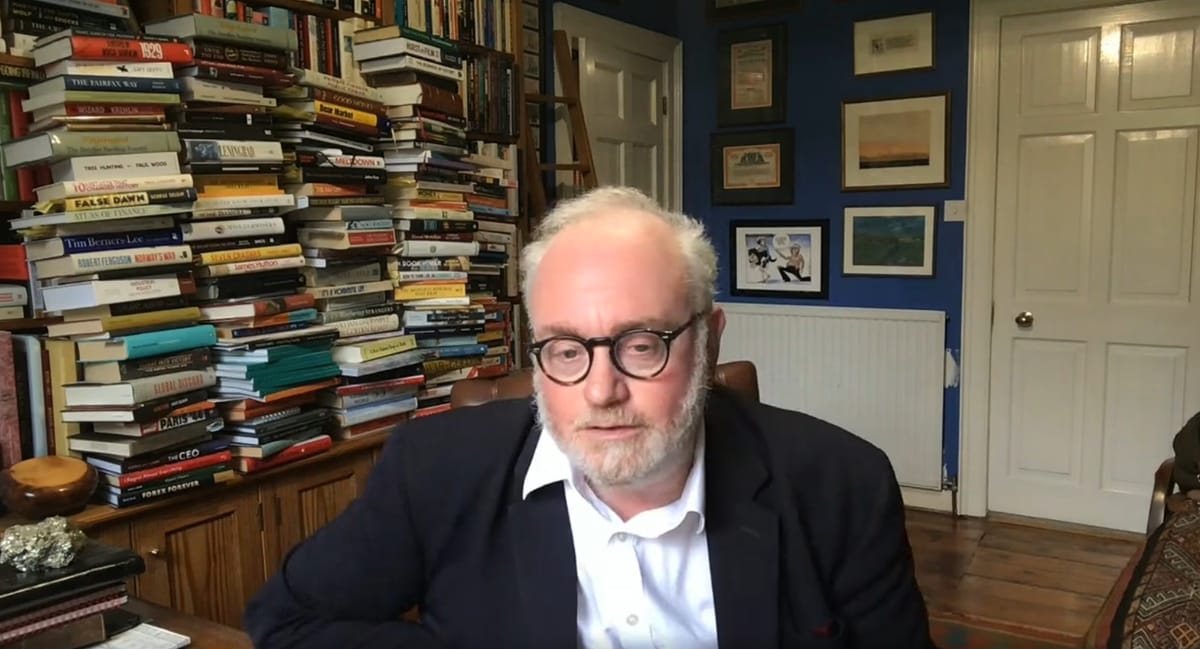
Professor Russell Napier is a world-renowned financial historian, global macro strategist, and author. He is often described as a "lawyer by training and a historian by necessity." The conversation took place on two dates: 23 February and 9 March. Between those two dates, a war began in the Middle East and Russell offers his thoughts towards the end of the transcript. A detailed biography of Russell is captioned at the end of the transcript. This link takes you to Russell’s course Practical History of Financial Markets.
Part I: Early life, education and influences
JS: Let’s go back to young Russell. When you think back, what were the specific influences of each of your parents?
RN: I’ll start with my father. My dad was a butcher; he worked in a butcher shop very close to where Kenneth Branagh lived. I often wondered whether they met—whether young Kenneth ever wandered into the shop—because my dad worked near Tiger’s Bay.
He would bring me in to work there from an early age for a very smart reason: he made it clear that if I didn’t pass my exams, I’d also be working in a butcher shop. There’s nothing wrong with working in a butcher shop, but it’s hard, cold work. Remember, there was no heat in there. There were no chairs; you’re constantly on your feet. That was all right when you’re 12, but as you get older, that’s pretty tough. The lesson from my father was clear. He was a determined man and fairly open-minded.
Regarding my mother she could get on with everyone. I think I’ve inherited that. Some of my best friends are people I disagree with, whether on markets or politics. People in Belfast have a reputation for not getting on with others, but in my experience, beyond the history of sectarian problems, they show a willingness to get on with just about anybody. I think that specifically comes from my mother.
JS: When you were growing up, were there any world events that seemed pertinent to you and have proved so even today?
RN: I was born in 1964 and the Troubles started in 1969. I grew up slap-bang in the middle of that, and it dominated the news. We were the world’s biggest net exporter of news, I think. But the event that stays with me—because it hit at an influential age, around nine—was the Watergate scandal.
When you watched the news from the mainland, that was dominating. I’ve always had a fascination with Watergate. It’s important because I went on to be a lawyer, and that relationship between the executive and the law is vital. And here we are again. At that period of history, there was a great distrust of government. If Watergate was your formational moment, you always had lurking at the back of your mind that the government is not necessarily working in your best interest or within the law.
JS: You mention law. You formally studied it—talk a little bit about that decision and where you did it?
RN: That’s easy because I’m useless at sciences. If you’re going down the arts stream, the most lucrative career is usually law. There wasn't a great deal of thought put into it. The media then was dominated by wonderful portrayals of lawyers saving innocent people from execution; you couldn't help but be influenced.
Queen's University Belfast was the only option because I couldn't afford to go anywhere else. Going away from home is an expensive business. My education was almost entirely at home, traveling in. There was another reason for that, James. In the first two weeks of my university career, our lecturer in constitutional law was assassinated outside the lecture theatre.
Nobody was ever convicted for this crime. Being in Belfast from 1983 to 1988 was a difficult time. I came from a little town by the seaside, which was very peaceful, so I didn't actually live in Belfast for my legal studies until my fifth year at law school. Things hadn't really gotten any better by then and the peace process followed after I left Northern Ireland.
JS: After that, how did you land your first job?
RN: I applied to Cambridge. Having spent five years not working for a living, I decided to extend it to six with a Masters in Law. The truth then, and today, is that study at Cambridge opens new doors. The reason I ended up in investment is simple: I fell in love with the city of Edinburgh.
The problem was I had spent six years studying English and Irish land law, none of which is acceptable in Scotland. I went to the career service in Cambridge and asked for jobs in Scotland. They pointed me to a filing cabinet. There was a single sheet of A4 from a small Edinburgh investment boutique called Baillie Gifford. That was the only job they had in Edinburgh. I applied, and it’s an amusing story how I got it.
JS: Do you want to explain how you landed that?
RN: I had to go to London to meet the senior partner. I had no idea what an investment manager was. He explained it and sent me to Edinburgh to meet the rest of the partnership.
Over lunch, they asked: "Given that you are a lawyer, how did you first come to hear of Baillie Gifford?" I said, "Well, you were the first ever successful prosecution for insider dealing."
Perhaps not the approach you want to take over lunch! I thought they were going to choke on their spaghetti, but to be fair, they seemed to think it was a good thing that I could be frank. Despite that stupid comment, they offered me the job which says a lot about them as a partnership. I suspect they were desperate and needed someone at short notice.
Part II: Asia, Strategy, and the Great Financial Crisis
JS: To which countries did you make your first trip to Asia, and what do you remember?
RN: It was incredibly glamorous. I started in the Japanese department, then the American department, and finally settled in the Asia department. This was when Asia, excluding Japan, was starting to grow rapidly.
The universe then were effectively Hong Kong, Kuala Lumpur, and Singapore. Bangkok followed those in importance. That covered about 80% of the market cap in 1991. There was no accessible China or India market then.
JS: You were at Baillie Gifford, then you moved into the brokerage research side. Talk around that.
RN: I left Baillie Gifford for Foreign & Colonial Emerging Markets, a fund management company. But I hadn't been there long when I was approached by CLSA to be Chief Regional Strategist in Hong Kong.
I was 30 years old. It says a lot about bull markets that a 30-year-old could be an "expert." We were in a bull market for Asian equities that peaked in December 1993. I lecture at Queen’s University on the Asian Financial Crisis now and point out that I was an indicator that there was a problem as there was so little true expertise in the asset class.
I got myself into trouble at CLSA because I was a bear. Everyone else believed in the "Asian Economic Miracle," but I thought it was a foreign debt-fuelled bubble.
JS: What were the attractive features of working at CLSA in Hong Kong?
RN: Secondary market broking was profitable then. CLSA produced high-quality research. It was founded by two journalists, and we felt we were telling Asia’s story. Because we weren't mainly in the primary issuance business, we weren't pushing new issues; we were telling the truth.
The biggest story was China. Being in Hong Kong, you could see the money coming in. There was a great deal of freedom at CLSA. I often disagreed with the Chief Economist, and we would publish diametrically opposed opinions. The boss told complaining clients it was "two opinions for the price of one." I’m not sure you could say that at JP Morgan.
JS: Are there any generally accepted theories of history you once believed but have since abandoned?
RN: I still believe in the mean reversion of equity valuations, but I’ve become sceptical about the timeframe. There is a Principal-Agent problem in our business. Agents (fund managers) are under pressure to deliver short-term results, so mean reversion doesn't always help them. Because their time horizons are short, they mostly cannot invest with that mean reversion in mind and these same incentives delay the mean reversion .
I’ve also realized the immense power of central bankers and governments to intervene to prevent mean reversion. I used to think they didn't have the power to stop it; the US central bank has proved me wrong. The ECB scrapped, in my opinion, its entire constitution to counteract the forces that would have brought a mean reversion of equity valuation.
JS: Have you developed your conceptual sense of money over time?
RN: Growing up in the 1970s and working in a butcher shop, I was very aware of the lack of soundness of money. Every Monday morning, we changed all the prices. UK inflation peaked at 27%, but meat inflation was higher. We dug up our back garden to grow vegetables because of unsound money. My recollection is that the price of chips doubled in 1976 and of course the price never came back down again! One day the half penny bar became the penny bar! That was an education in the consequences of unsound money at an early age.
The history of money is not one of sound money; it’s the reverse. Democratic states can’t really live with "hard money." I’m not in the camp that deplores the lack of hard money; sometimes the state needs a little "oil in the machine" to hold a democratic system together. Sound money is highly unlikely in a democracy because of the need for debt relief. How unsound you can afford it to be, before it tips a society into turmoil, is the subject of a great deal of history.
JS: Can you name people who produce arresting thoughts but are underappreciated?
RN: Jim Grant of Grant’s Interest Rate Observer. Every time I pick it up, I learn something about mechanisms. Also, Andrew Smithers. I don't always understand everything he says, but I never come away knowing less than when I started. I’ve also learned a lot from Gordon Pepper and John Greenwood. I find mechanisms much more interesting than forecasts.
JS: You live outside Edinburgh. What does it mean to be a Northern Irish person living in Lothian? Do you practice neutrality regarding Edinburgh football?
RN: First of all, I am a "NIPPLE"—an acronym for a Northern Irish Professional Person Living in Edinburgh. I don't practice neutrality on football for accidental reasons. I’ve ended up as a supporter of Hibernian Football Club (Hibs), though I’m too busy to go much now.
However, I also find myself at Tynecastle, the home of Hearts, because I have friends there who insist on taking me along as long as I keep quiet. As someone who came to Edinburgh, I find myself supporting both Edinburgh teams against the Glasgow rivals. There’s a certain history to the two Glasgow teams (the Old Firm) which, as I get older, I find quite disturbing. I’m one of those few Hibs supporters who would quite like to see Hearts win the league this year. Hearts are top, and I would be delighted if they won—though now I may not be allowed back into either ground! I’ll have to get a disguise.
JS: What does "getting away from it all" mean for Russell Napier?
RN: Primarily fishing. I think fishing is still the biggest participation sport in the UK. In my case, it’s definitely "fishing" and not "catching," but it takes the mind to neutral in a way that lying on a beach doesn't. When you’re fishing—particularly dry-fly fishing down in Hampshire—you’re concentrated on that space.
It also takes you to some of the most beautiful places. I live near the River Tweed. If I walked into the middle of the river in waders, somebody would phone the police thinking I was a danger to myself. But if I’m holding a fishing rod, nobody thinks twice. It’s a legitimate excuse to stand in the middle of a river and watch the world go by.
Apart from that, I’ve become a collector of a specific type of coin: one-ounce silver coins. From roughly 1545 to 1978, these were the closest thing we had to a global currency. Most countries produced a "Crown-sized" or "Thaler-sized" silver coin. The most famous is probably the "Pieces of Eight," the base of the Spanish Empire. They were exchanged across the planet; you could use them in Edinburgh as easily as in New York or Boston. Each of these coins has a story. Unlike gold, which is a store of value kept in a safe, silver coins are often battered and beaten up because they’ve actually been somewhere and done something.
JS: Explain the genius of the Library of Mistakes in Edinburgh and what kind of resource it is.
RN: It’s really a business and financial history library, but if we called it that, nobody would turn up. We have 5,000 publications, including a complete run of The Bankers' Magazine from 1845. It’s fascinating to read the contemporaneous opinions of bankers about the future—they were no better at forecasting then than they are today.
There are branches in Pune, India, and Lausanne, Switzerland. We are opening more this year, including one inside the National Library of Singapore. Edinburgh is a library for the 21st century; it converts into an auditorium for events that are live-streamed and recorded for our podcast.
We are becoming a global movement because people are recognising that the way finance has been taught over the last 40 years—the focus on spreadsheets, correlations, and volatilities—is insufficient. It has stripped out philosophy, sociology, psychology and much more. A quick way to put those back in is to study financial history. Even Nobel Prize winners like Angus Deaton have said we need financial historians more deeply involved in economics. It’s all a charitable activity under a charity I founded called Didasko (https://www.didaskoeducation.org.uk/), which also does educational work in schools amongst other things.
JS: There’s a phrase: "separate the noise from the signal." What does that mean to you?
RN: It’s why financial history is important. You need to study as wide a range of outcomes as possible. If you’ve lived in the developed world for the last 30 years, you’ve seen a fairly narrow range of outcomes. Since the Great Financial Crisis, that range has widened significantly. To understand the implications for markets, you have to go back in history to see how markets reacted to different extremes. People are realising they have no experience dealing with the current range of outcomes. The beauty of the library is: why make mistakes of your own when you can learn from others?
JS: What topics and people might you cover in your podcasts over the next 12 months?
RN: I wish I had a formal plan, but it depends on what good books I read! I just read one on the American Revolution and money—the first time the American currency went effectively to zero. We’ll cover that monetary union experiment. There’s also an interesting new book on the Swiss franc as a store of value. And I can say that we’re going to have Jeremy Grantham at the Library of Mistakes talking about his new book, which we’ll turn into a podcast. We look for lessons for the present, focusing on mechanisms of price determination rather than just repeating patterns.
JS: You are connected with several educational establishments. What have you done with them?
RN: I set up a course called "The Practical History of Financial Markets" at Edinburgh Business School in 2004. The university renamed it "Advanced Valuation in Financial Markets," which I find peculiar. Finance faculties often don't think history matters if they still cling to the Efficient Markets Hypothesis. I do think ‘history’ sells and certainly institutional investors queue to take the course these days.
I’m also a visiting professor at Heriot-Watt, an honorary professor at the University of Stirling, and I lecture at Queen’s University Belfast. Queen’s is pioneering work in financial history; John Turner and Will Quinn wrote Boom and Bust, and I give an annual lecture there on the Asian Financial Crisis in a module they have based on their great book. Additionally, my charity awards scholarships across UK universities, including Cambridge.
JS: If you hadn’t had this career, what else might you have done?
RN: If I hadn't passed my 11-plus exam, I would have been a butcher. That is absolutely true. Given that I studied law, I probably would have ended up as a lawyer in Belfast. But I think I’d have been a dreadful lawyer. I find reviewing legal contracts tedious compared to financial markets. The image of standing in court defending the innocent is rarely the reality for most lawyers. I’d likely have been a miserable lawyer.
JS: Last question: what advice would you give to a school leaver today?
RN: Try to find a career where every day is different. You don’t have to "love" your job, but you have to like it. I would put monetary considerations second. If you don't want to do it every day, what a waste of a life. A job where you learn something every day is to be prized and pursued and fortunately that is the job I found straight out of university in 1989.
I also think the music of Bruce Springsteen is important. His songs are often about people who had "Glory Days" at school and never replicated that success, always looking back at lost chances. I listened to that message when I was young. Whatever you do, make sure you want to do it and take your chances. If that means getting paid less, so be it. Sacrificing your daily happiness for a higher salary is a true false economy.
RN: The day I was born was the day Harold Wilson was elected Prime Minister for the first time. Same day. My brother got me a 60th birthday card with a photo of Wilson that night with his arms in the air and the headline: "Congratulations, it’s a boy."
JS: He was a "boy wonder" but probably looked 60 even then because people looked older back then—and he was likely already a pipe smoker.
RN: Absolutely true. He looks 60 in the photo, but he was probably only 40 [FSP: he was 48 years old].
Part III: The Library of Mistakes and the current war in the Middle East
JS: Talk me through your last few years at CLSA and what that was like?
RN: The last few years at CLSA were post-Great Financial Crisis. CLSA had not changed in terms of oversight—there was none, which was tremendous. I was working with a great colleague, Chris Wood. We found a way of working together by covering different angles and not talking about it much. Most firms with a strategist of Chris Wood’s quality would find it difficult to have another one working alongside—often agreeing, often disagreeing.
The GFC meant people wanted more macro. I’ve watched this cycle over and over: the stock pickers who say they never want macro input suddenly want it at exactly the wrong time.
My biggest call in that period was when CLSA organised a banking conference in New York. We had Paul Volcker speak. The CLSA banks analyst Mike Mayo and I questioned him on the floor of the Plaza Hotel. You don’t forget that easily. Of course, he was even better than Muhammad Ali at avoiding punches; we didn't get much out of him. But I realised then that senior commercial bankers were going to find it very difficult to expand their balance sheets due to regulation.
I concluded that bank credit growth and money supply wouldn't expand much, and therefore we wouldn't have the inflation everyone expected from the expansion of the central bank balance sheet. By 2011, I changed my mind and thought inflation would come down. That was spot on, inflation went from 4% in 2011 to a negative number by 2015. The problem was, I said that would be bad for the stock market, but the market went up. Lesson learned: the journey from high inflation to lower inflation, even very low inflation, is a good one for equities particularly if it comes with some economic growth. It was a good macro call but a bad strategy call.
Part IV: The Independent Path
JS: At a certain point, you decided to leave CLSA. Did you have a set idea about what you wanted to do next?
RN: No, just more of the same, but independent. I wanted no restrictions on opinions. Over the years, that morphed into having to be more sophisticated as an individual regarding packaging and pricing. I didn't have to think about sales at CLSA because I had a fantastic team. That changes quite a bit when you’re independent.
JS: Who was helpful to you as you established yourself?
RN: I spoke to many independent analysts. The abiding piece of advice was: "Start with a high price, because you’ll never be able to put it up."
JS: Talk me through the economics of being an independent analyst.
RN: The fixed costs are reasonable. The real difference is the sales function—needing someone to liaise with clients. I established ERIC (Electronic Research Interchange) to provide these services for independent analysts. There was a hope that under MiFID II, more analysts would flock to the banner and fund managers would stop paying via commission.
However, fund managers were still able to receive research at subsidised prices from brokers despite the legislation. Analysts weren't as brave as I thought they’d be in becoming independent. My research business is fine, but the ERIC platform never benefited from that structural change in research procurement because the legislation didn't deliver what it promised.
Part V: Writing, Data, and Worldviews
JS: You are known as a prodigious writer. How do you decide what to write about next?
RN: At CLSA, you had to write daily strategy. "Daily strategy" is at the top of the list of oxymorons. You have to find a big worldview and update it as you progress. You can’t change your opinion all the time. You form a thesis and then look at data to see if it contradicts you.
Think of it like a seesaw: is the drip of information tipping you toward belief or disbelief? No one reads my report for trading advice; they want a 12-month timeframe. Sadly, more of that data has become politics and geopolitics rather than pure economic data.
JS: What are your most-used data sources?
RN: All official data. I do macro, so I look at GDP, but more importantly, balance sheet data: net international investment positions, size of commercial bank balance sheets, and credit-to-GDP. These aren't always analysed because people are fixated on inflation and growth. The secret is to ask the right questions of balance sheets and often balance sheets are not important until they are really important.
JS: As you travel, do you discern ingrained differences in worldviews between managers in Asia, Europe, and North America?
RN: The massive change is in America. In 1995, I could talk about Indonesia and people knew where it was. Now, that’s gone. The success of American equities has wiped out expertise in anything beyond America. That is exceptionally dangerous for a country with a large current account deficit and a massive debt-to-GDP position. America thinks it’s an island—metaphorically and literally—and that the world just follows.
That international expertise survives in London and Edinburgh. Asia remains very parochial; funds are raised to invest in Asia and global investment is delegated, on the whole, to fund managers in other regions. Singapore is the exception; it’s becoming more international.
Part VI: The Study and the Camper Van
JS: You’re based in your study outside Edinburgh. Is that where you do all your writing?
RN: I’m desperately trying to write somewhere else, but I find it difficult. I’ve been coming to the same desk since 1998. I bought a portable desk and a laptop, but so far, everything has been written here. I’m surrounded by books which have become a "comfort blanket."
JS: The books are almost floor-to-ceiling. Could the portable desk go in the camper van?
RN: Absolutely. I’ve done quite a few conference calls from the back of the 1961 camper van. When the family was younger and the holiday house was noisy, I went to the VW to do calls. Once, I was talking to a hedge fund manager, a German tourist opened the door, stuck their head in, and told me how wonderful the van was. They wouldn't go away. I can talk to fund managers from the van, but I struggle to write there.
Part VII: Investment Committees and The Practical History of Financial Markets course
JS: You serve as an external investment committee member. What makes a good one?
RN: You have to understand the constraints: regulators, internal risk, and so on. It is good not to have too many opinions. If a committee has three members each with ten opinions, it’s tricky. My role is as an educator. If I can leave a room and the decision-makers are thinking differently or have a new angle, that’s success.
Joining a committee forces you to listen, which is a great discipline. I’ve spent 61 and a half years learning to listen and I still haven't mastered it.
What we really need are books about financial repression. I talk about it a lot, but there is no definitive book on financial repression as it impacts returns on financial instruments. If anybody reading this has a spare couple of years, there is a tremendous opportunity to write that book. Five or six years from now, everyone will be writing about it because it will be the air we breathe.
There is a historical parallel, but few great books were written about it at the time because when it's the air you breathe, you take it for granted. If you are from Brazil or South Africa, you are already well-schooled in financial repression. I’m looking forward to the books we’ll get about what we learn from previous financial repressions and how to manage money in those environments.
JS: Who is the course built for?
RN: It’s available online, so you don’t have to turn up in person to take it. We launched that course in 2004 because I thought financiers didn't know enough financial history. When I joined the investment industry in 1989, there was a mishmash of skill sets in investment management. As time progressed, the community increasingly hired people with degrees in accountancy, economics, and finance. Some call that "professionalisation," but when you’re in the business of forecasting the entire planet, I don’t think that specialisation is a good thing.
The course was launched to push back against the "over-mathematisation" of economics and finance. Some of the original teachers are still with us. The syllabus was devised by getting fund managers with at least 30 years of experience in a room and asking: "What do you know today that you wish you knew 30 years ago?"
We first seek the best measure of value that tells you something about the future. Once you’ve established that, you look at the forces that bring mean reversion to equity valuation. We cover historical return data for equities, bonds, cash, and gold. The goal is to determine when you should have high or low weightings in equities.
We also discovered that you cannot get people in a room and not talk about the future, so we tagged on a session at the end where I talk about the future—otherwise, they pester us for the entire two days. Edward Chancellor has also joined. He has done a great deal of work on the Capital Cycle: the way you mesh bottom-up investment with top-down investment. It's an exciting place where the two meet.
Not everybody gets to live through a structural change, but this generation of investors is. We’ve lived through them before, and there are things you can learn from previous changes to help with the next one.
JS: And who is taking the course now?
RN: It used to be professional fund managers, but it's morphing quickly to high-net-worth individuals—people taking responsibility for managing their own money who are perhaps underwhelmed by the offerings of the traditional investment management community. We have a whole set of "self-advised" investors using platforms and making their own decisions. A lot of them are smart enough to know they need educating. It’s a delight to have them because, in any walk of life, there is a risk of only having agents in the room. As our course fills up with more principals, we get better questions.
JS: That makes sense. And the frequency and locations of the course?
RN: Currently, the in-person course runs twice a year in London; the next ones are in June and September. The online course is available through the Library of Mistakes website. Didasko is the overriding charity that handles the course and the libraries—because there’s more than one library. We also run a competition in schools to get girls interested in finance and teach personal finance in the Lothians in Scotland. That little charity has morphed into something significantly bigger.
Part VIII: War in the Middle East
JS: To bring it to today: we have an enveloping war in the Middle East. Walk me through the thought process as you attempt to locate a "longer view" within this.
RN: Structurally, the old monetary system focused on the link between the Dollar and the Renminbi has created massive imbalances. These manifest as excessive levels of total debt-to-GDP in the developed world—government, household, and corporate. Something will have to be done about that. As they say in Ireland, "It depends where you start." We know where we start: record high levels of debt...
Now, you put a rise in the oil price on top of that. What does that mean? The most socially acceptable way to deal with high debt-to-GDP is to inflate it away. That isn't just about higher oil prices; it’s about pushing up inflation and creating higher nominal cash flows for individuals, corporations, and governments. A higher oil price doesn't bring that—unless perhaps you live in Norway.
The developed world has a real problem here. This comes at a time when broad money growth is very low—for some countries, even lower than it was in the 2009–2019 period. It is ridiculously low. That is an intellectual mistake by the central bankers, who are determined to live in a world where the price of money (interest rates) is the key monetary variable and broad money growth is not important. We could have a long chat about why they constantly make that intellectual mistake, but here we are again.
The markets believe some central banks are about to raise interest rates because the oil price is up; that would be a disastrous mistake at this stage. This environment potentially forces a mistake, leading us toward financial repression. This is the nightmare scenario for governments: lower growth and higher bond yields, which is what we have seen in the first few days of this war.
We have to assume they’ll do something about it, which means this is a trigger for more aggressive financial repression. The two key elements—which may take a month or two to emerge—are that you need to accelerate the growth in bank credit and broad money growth, and you need to force people to buy government bonds at yields the state can afford to pay. This war will go down in history as a catalyst for that.
Now, if the oil price collapses—for instance, if we see a regime change and that regime decides to export all its oil to America and Europe rather than China—then that is all postponed, but it is a matter of postponement rather than cancellation. The great seminal moment is when we realise that central bankers get it wrong—which isn't a surprise—but also that they are overridden by governments dealing with national emergencies. The TIPS market show inflation expectations remain anchored but this will change in a national emergency in which the government needs central bankers to accommodate inflation rather than create a recession.
I always recommend people read that incredible speech Arthur Burns, former chair of the Federal Reserve, made in 1979 in Belgrade; it's called "The Anguish of Central Banking." He describes how, during great supply-side shocks in oil, they accommodated that inflation rather than fought against it. That is where we end up. Central bankers cannot ultimately fight this supply-side shock with tight monetary policy. This runs concurrent with another supply-side shock: our unwillingness to import as much from China given our over-reliance on them.
Central bankers might try to fight those, but they will be overwhelmed. The "anchoring" of inflation expectations—which took a long time to establish through the Volcker years and perhaps fully anchored the day he handed over to Greenspan in 1987—is finally over. In a national emergency, you do what you’re told.
JS: Are you making fresh shelf space available in the expanding Library of Mistakes for the financial consequences of this war?
RN: Yes, of course, because policymakers are always fighting the last battles. I think it is possible that some central bankers will raise interest rates because oil prices are up. I think that’s a fundamental mistake, both cyclically and structurally. Cyclically, it means real economic activity takes a bigger hit and debt-to-GDP goes even higher. Structurally, they don't want to recognise the truth that debts have to be inflated away.
Their mandate is not to inflate away debt; they are sticking to their mandate. But the time has come when a new mandate is necessary. President Macron has spoken of this already. I think we’ll have a whole chapter on the errors of central banking in this phase.
JS: Is cash the play because all the putative havens don’t really work right now?
RN: Well, if the oil price stays up, we are at a seminal moment. Do the central bankers raise rates? Everyone is betting on the ECB raising rates, which is insane. Broad money growth is 3%, and there’s no bank credit growth in Germany or France. Maybe they’ll do it. As you remember, Trichet did that in early 2008.
They can’t force the economy through a huge contraction just to keep inflation low because oil prices are up. This is the moment we realise that, politically, they don't have that power. If the oil price collapses quickly, it’s not a seminal moment. But if it hangs for a while, people will realise what central bankers really are. Cash produced poor real returns in the great structural change when the Bretton Woods agreement collapsed but the returns far exceeded those from bonds and equities for several years.
JS: I have an analogy from rugby. Part of the problem with the English team is they play to instructions from the head coach. Until that last game, they lacked agency. If central bankers are robotic because they’re programmed to respond to inflation, they might just do the wrong thing.
RN: There’s every chance they’ll do the wrong thing, but they won’t do it for long given the consequences. I think they are conditioned like Pavlov's dogs.
Whereas with Scottish rugby, Finn Russell turns up without a formula and suddenly things start working. The guys can sort it out amongst themselves. A coach of yesteryear, Frank Haden, had that siege mentality with Scottish rugby—they always only lost by a few points, but they never scored many points. It is not easy to be on the front foot, to live life on the front foot, but particularly at times of great structural change investors need to do something different and abandon what have been a tried and tested formula. Almost all institutional investors get instructions from head coaches whether they be their CIO, the internal risk control department or the regulator. It takes not just intelligence but bravery to depart from those instructions. Private investors are under no such instruction. They have a profound advantage in securing positive real returns over institutional investors in this period of structural change.
I recently read Field Marshal Viscount Slim’s history of The Burma Campaign. He couches his ultimate victory through a desperate scramble to get his forces onto the front foot. Once on the front foot they could throw good punches and they did against an enemy they previously considered invincible. I’m afraid that most of the investment industry is already and will be further limited to sitting back and defending on the back foot. The individual investor should seize their advantage.
Russell Napier
Russell Napier established his academic foundation at Queen’s University Belfast, where he earned an LLB (Hons), before completing a Master of Laws (LLM) at Magdalene College, Cambridge. He began his professional career in 1989 with the renowned Edinburgh-based asset manager Baillie Gifford, where he initially gained experience managing Japanese, US, and Asian equity funds. In 1995, at the age of thirty, he relocated to Hong Kong to join CLSA as Chief Regional Strategist. During this tenure, he achieved significant industry acclaim for his foresight in predicting the 1997 Asian Financial Crisis, a feat that secured him the top ranking in the prestigious Institutional Investor poll.
Since 1995, he has authored The Solid Ground, a highly respected global macro strategy report for institutional investors which began at CLSA and has since transitioned into an independent publication. His literary contributions include the 2005 work Anatomy of the Bear: Lessons From Wall Street's Four Great Bottoms, which the Financial Times described as a ‘cult classic’, and the 2021 publication The Asian Financial Crisis 1995–98: Birth of the Age of Debt.
A dedicated advocate for financial history, he founded the Library of Mistakes in Edinburgh in 2014. This charitable business and financial history library were established to ensure that the cyclical errors of the financial world are preserved and studied. He further contributes to the sector as the founder and course director of the ‘Practical History of Financial Markets’ module, an integral component of the MBA programme at Edinburgh Business School, Heriot-Watt University. His academic standing is reflected in his appointments as a Visiting Professor at Heriot-Watt University and an Honorary Professor at the University of Stirling.
In his current professional capacity, he serves on the investment committees of three fund management companies, including Cerno Capital. He remains a prominent commentator within the industry as a frequent lecturer and podcaster and continues to be a regular contributor to the Financial Times and various other leading financial publications.